
By Mirà Kanehl · Historical fiction author researching early nineteenth-century New Orleans, Barataria, and Jean Laffite
Stand on Grand Terre in the early 1810s and New Orleans is close enough to trade with, yet inconveniently difficult to pass if one happens to carry illegal cargo.
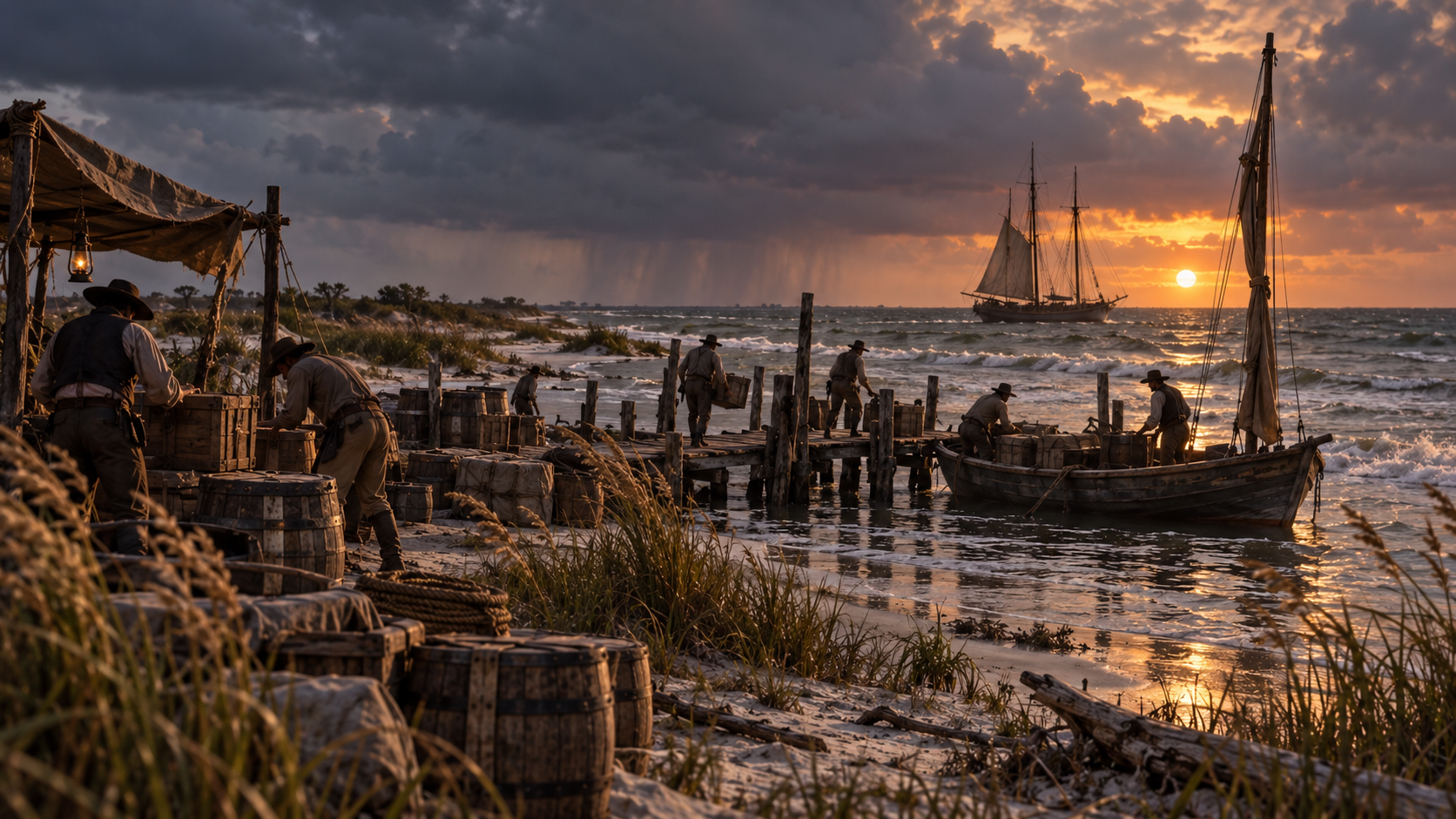
Beyond the low barrier island, the Gulf flashes beneath a hard Louisiana sky; behind it, you know Barataria Bay dissolves into marsh, bayou, lake, and strips of ground that appear firm until one has the poor judgment to step on them. Rigging knocks against masts, surf works the shore, gulls quarrel overhead, and men call over cargo being shifted across rough timber. The air carries salt, tar, damp wood, tobacco, sweat, and vegetation slowly cooking in the heat; humidity presses linen against the skin, while brine settles in the creases whether one has entered the Gulf or merely spent enough time near it. Where wind permits, mosquitoes swarm.
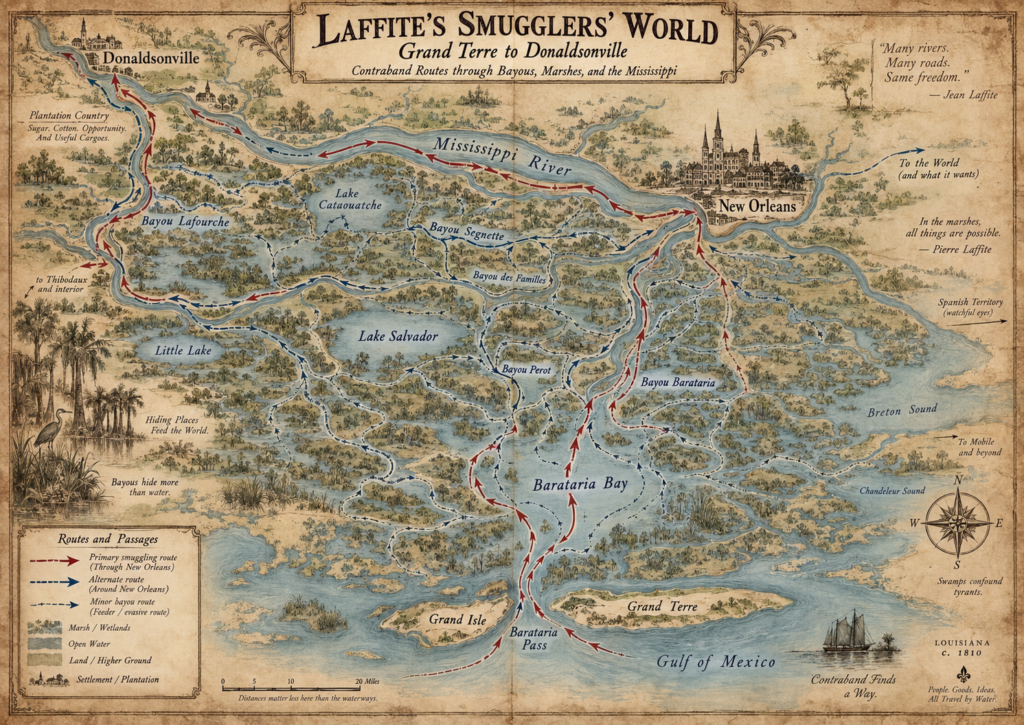
Jean Laffite—whose surname is also frequently rendered Lafitte in modern references—and his brother Pierre built their Louisiana business inside this landscape. Barataria gave them access to the Gulf, protected water behind the barrier islands, routes toward New Orleans, a western corridor toward Bayou Lafourche and Donaldsonville, and enough alternative channels to make enforcement of law an exercise in patience, local knowledge, and occasionally humiliation.
By about 1812, Grand Terre had become the principal headquarters associated with Jean Laffite and the Baratarians. Ships, smaller craft, warehouses, auctions, merchants, planters, sailors, pilots, laborers, armed men and buyers all became parts of a commercial system extending far beyond the familiar image of a pirate standing beside a cannon.
How Did Jean Laffite’s Smuggling Network Work?
In brief, Jean and Pierre Laffite used Grand Terre as a coastal depot, where cargo arriving through the Gulf could be unloaded, stored, divided and sold. Buyers sometimes traveled directly to Barataria for auctions, while other merchandise could move inland in smaller vessels through the lakes, bayous and marsh channels approaching New Orleans.
To the west, Bayou Lafourche still connected with the Mississippi River at Donaldsonville, opening access to plantations, settlements and markets beyond New Orleans. The brothers also understood how commerce worked on paper as well as on water; at least one scheme described by historian William C. Davis exploited customs manifests so that contraband loaded after a vessel left New Orleans could later return with official documentation apparently matching its cargo.
The system depended on geography, but geography alone could not sell a bale of cloth. People and paperwork made it profitable.
Jean Laffite’s Smuggling Network at a Glance
| Stage | What happened | Key place |
|---|---|---|
| Gulf arrival | Captured or illicit cargo reached the Louisiana coast | Gulf of Mexico |
| Coastal depot | Goods could be unloaded, stored, divided and auctioned | Grand Terre / Barataria |
| Inland transport | Smaller craft moved cargo through lakes, bayous and marsh channels | Barataria Basin |
| Eastern market | Merchandise could enter commercial networks around New Orleans | New Orleans |
| Western corridor | Bayou Lafourche connected coastal country with the Mississippi | Donaldsonville |
| Paperwork schemes | Customs documents could sometimes be exploited to disguise contraband | New Orleans / Lafourche |
| Distribution | Merchants, planters, intermediaries and buyers moved goods onward | Mississippi corridor |
The table looks simple enough. The real water was swampy.
Barataria Was a Region Before It Was a Pirate Headquarters
The Barataria Basin lies between the Mississippi River to the north and east, Bayou Lafourche to the west, and the Gulf of Mexico to the south. Its interior divides into lakes, bayous, marshes, natural drains and narrow waterways, while Grand Isle and Grand Terre sit near the Gulf entrance beside Barataria Pass.
A modern map gives reassuring edges, but historical water was less considerate. Channels silted, storms altered barrier islands, high water made passages usable that could later become shallow, sediment shifted and marshland subsided. A craft suitable for the open Gulf could unexpectedly land farther inland; a shallow pirogue useful among the bayous was less impressive if one attempted to take it cheerfully to sea.
Knowing that a waterway existed was therefore insufficient. One needed to know what kind of boat could use it, whether it still held enough water, what recent weather had done to it, where one might land, what connected with what, and whether government officers had suddenly developed an unhealthy interest in that particular route.
The Baratarians had such knowledge. Government officers often had maps. That made all the difference.
Grand Terre was especially useful because it stood between two worlds. Gulf-going vessels could approach the coastal base, cargo could be unloaded and stored there, buyers could come south, while merchandise intended for inland markets could be divided and transferred onto smaller craft better suited to Louisiana’s interior waterways.
Grand Terre Became a Marketplace
Smuggling sounds more clandestine when conducted under moonlight, preferably by men whispering beside a suspicious lantern.
Barataria could be considerably more commercial. The Laffites and their associates developed storage and trading facilities around Barataria, while merchants, planters and other buyers traveled south to purchase merchandise at auctions beyond the ordinary customs system of New Orleans.
This transformed the operation. Every crate did not have to be smuggled all the way into the city by Jean’s own men. Cargo could be brought to an established depot, stored, divided, offered for sale and transferred to people who then assumed responsibility for carrying their purchases onward.
The seller shortened his transport chain. The buyer acquired cheap goods. The risk became communal.
The merchandise passing through Barataria included imported goods such as textiles and other desirable commodities, but any account of the operation becomes dishonest if it stops with attractive bolts of cloth.
The Baratarians also participated in the illegal trafficking of enslaved people. Congress prohibited the international importation of enslaved people into the United States from 1808 onward, while slavery itself remained legal in Louisiana and demand for enslaved labor remained enormous. The contradiction created an appalling commercial opportunity: a person could be brought illegally into the country and then sold into a society in which enslavement remained lawful.
The Baratarians exploited that market. Pirate history becomes less romantic when the ledger is opened. That is no reason to close it.
Why Smuggling Paid So Well
New Orleans sat at the lower end of one of the richest transport systems in North America. The Mississippi connected the city with an immense interior, while the Gulf opened outward toward the Caribbean, Mexico, Europe and Atlantic trade.
Legal imports also arrived accompanied by inspection, customs duties, restrictions and paperwork. During the years surrounding the War of 1812, American trade restrictions and wartime disruption made access to some foreign goods more difficult or expensive. Contraband that escaped the ordinary import system could therefore be sold cheaply enough to tempt buyers while still leaving substantial profit for the people supplying it.
The government’s difficulty becomes obvious at this point. Officials were attempting to suppress a business many of their own citizens wished to patronize. Merchants wanted goods. Planters wanted goods. Customers preferred lower prices. The Laffites supplied all three and apparently expected the customs service to appreciate the competitive environment.
It did not.
Contemporary officials complained about the difficulty of enforcing the revenue laws when local commercial interests benefited from the Barataria trade. The Laffites therefore enjoyed an advantage far more useful than secrecy alone: part of respectable society had a financial reason to keep the disreputable system functioning.
Jean had geography. He also had customers.
Sometimes the Best Way Past Customs Was Through Customs
One of the more entertaining schemes attributed to the Laffite operation shows why their business deserves to be understood as more than barrels moving secretly through reeds.
They understood paperwork. Historian William C. Davis describes a customs scheme used after the brothers had assembled a small fleet of vessels capable of moving between legal and illicit trade. A vessel could enter New Orleans carrying legitimate cargo, clear the port, and take provisions aboard for an outward journey.
Before leaving, however, its manifest could describe something rather more interesting than the merchandise actually aboard.
Contraband waiting elsewhere in the Laffites’ network was entered on the document instead.
Customs officers were chiefly concerned with goods coming into New Orleans because imports produced revenue, while outward cargo attracted less attention. Once the document had been certified, the vessel possessed official paperwork describing cargo it had not yet loaded.
Then came the clever part.
How the Customs-Manifest Trick Worked
- A vessel entered New Orleans through legitimate commerce.
- It prepared to leave with ordinary outward cargo or provisions.
- Its certified manifest instead listed contraband waiting elsewhere.
- The vessel sailed toward the Bayou Lafourche area.
- The ordinary cargo was exchanged for the contraband already named on the paperwork.
- When the vessel returned, the merchandise aboard corresponded beautifully with the official manifest.
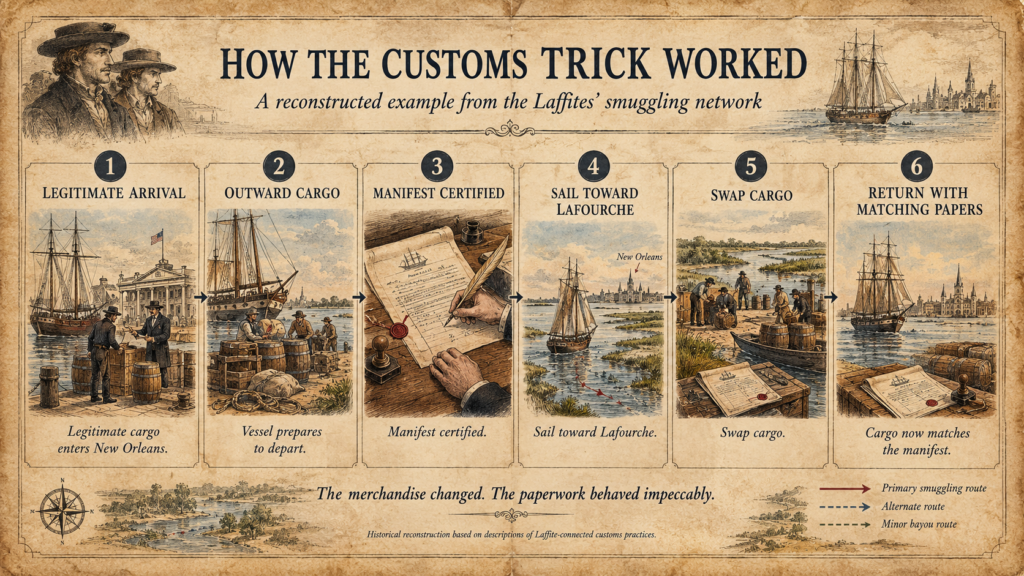
The merchandise had changed.
The paperwork had behaved impeccably.
There is something almost artistic about persuading a government officer to authenticate the document that will later make your contraband appear respectable.
Surviving Laffite-related records show how thoroughly their maritime world overlapped with ordinary administrative procedure. The Historic New Orleans Collection preserves 1813 material concerning vessels associated with the brothers, including a certificate of inspection, a crew roll for the Diligente, and a request concerning a letter of marque.
Piracy eventually encounters bureaucracy.
The clever pirates learn to use it.
The History Behind The Adventuress
I researched these waterways and commercial tricks while writing The Adventuress, the first installment in my One Virtue And A Thousand Crimes series. Jean Laffite enters the story as a real historical figure; Cosma Drilo, the woman complicated enough to interfere with his plans, is entirely mine.
How Contraband Reached New Orleans Through Barataria
The inland route toward New Orleans depended upon a succession of lakes, bayous, natural channels and canals rather than a single secret waterway known only to men wearing dramatic hats.
That multiplicity was the advantage.
Cargo arriving at Grand Terre could be divided into smaller consignments and transferred to craft suited to shallow water. As the route narrowed, practical knowledge became more important: how much water did the boat draw, which channel remained open after a storm, which bank provided a usable landing, whether revenue officers were watching the obvious route, and whether another passage made more sense that day.
The answers changed.
That was useful.
A road can be watched at a bridge.
A network of interconnected wetlands forces an officer to predict which part of it matters before the merchandise has been divided among several boats and scattered in several directions.
Authority floats poorly in shallow water.
Why Bayou Lafourche and Donaldsonville Mattered
The western side of the region gave the Laffites another important commercial corridor.
During their era, Bayou Lafourche still connected directly with the Mississippi River at Donaldsonville. The connection was not closed until the twentieth century, which makes the bayou’s historical importance easy to underestimate from a modern map.
In the early nineteenth century, following Lafourche north brought a traveller toward Donaldsonville and the Mississippi; following it south led through plantation country toward the Gulf.
Donaldsonville therefore mattered for more than its location on a map.
It connected coastal Louisiana with the great river economy.
Contraband did not have to end in New Orleans simply because New Orleans was the dominant port. Plantations and settlements along the Mississippi wanted merchandise too, and accounts of Laffite activity place contraband and agents in the Donaldsonville area and other inland markets.
This made the system broader than a single route running from pirate coast to city.
The network could enter New Orleans.
It could also go around it.
The customs-manifest scheme and the Lafourche corridor illustrate two complementary forms of intelligence. One exploited the rules written on paper; the other exploited Louisiana’s geography.
Jean apparently saw no reason to choose.
Then the Earth Moved
Louisiana waterways changed through ordinary processes—flood, sediment, storms, erosion, subsidence—and in 1811 and 1812 the wider Mississippi Valley gave its inhabitants a far more dramatic reminder that even geography could be temporary.
Beginning in December 1811, the New Madrid earthquake sequence convulsed the central Mississippi Valley. Major shocks and numerous aftershocks caused banks to collapse, fissures to open, areas of land to rise or sink, islands and channels to change, and water to surge violently; subsidence associated with the earthquakes helped form Reelfoot Lakein what is now northwestern Tennessee.
Reelfoot Lake was far upriver from Barataria, and the earthquake did not suddenly create a new lake beside Jean Laffite’s headquarters.
New Orleans felt it nonetheless.
Contemporary newspaper reports from the city describe shocks in January and February 1812 strong enough to stop clocks, rattle glassware and crockery, swing chandeliers and wake sleeping residents, some of whom apparently concluded that burglars had broken into their houses.
Imagine New Orleans in 1812.
The territory had only recently become American. Louisiana was entering statehood. War threatened. Smugglers were irritating the government. The earth began moving beneath the bed.
Naturally, one suspected thieves.
The earthquake sequence matters here because it exposes the larger truth of the Mississippi landscape: waterways were never permanent infrastructure in quite the way a paved road encourages us to imagine. Floods shifted sediment, storms attacked the coast, marshes subsided, banks eroded, channels changed depth and, during those extraordinary months, the earth itself joined the planning committee.
A smuggler who relied too confidently on last year’s geography could discover the amendment in mud.
What Can We Actually Know About Laffite’s Routes?
This is where the historical record deserves a little discipline.
Well documented
Grand Terre served as a major Baratarian headquarters. Cargo was stored and sold around Barataria. Merchants and planters participated in the trade. Bayou Lafourche connected the coastal region with the Mississippi at Donaldsonville. Laffite-connected vessels and official paperwork survive in archives. Government authorities repeatedly attempted to suppress the network.
Strongly supported reconstruction
The larger corridors through Barataria toward New Orleans and through the Lafourche region toward inland Louisiana can be reconstructed from geography, contemporary accounts and later historical research.
Usually unknowable
The exact sequence of minor bayous followed by one particular boat carrying one particular consignment on one particular day is rarely preserved.
The missing line on a map is not always missing research.
Sometimes it is the honest answer.
There Was No Single “Laffite Route”
For this reason, drawing one beautiful red arrow across southern Louisiana and calling it Jean Laffite’s smuggling routewould give the past a tidiness it did not possess.
The network worked precisely because routes could change.
Water depth changed. Weather changed. Patrols changed. Destinations changed. Cargo changed. Boat size changed. Local information changed.
When enforcement increased around one landing place or corridor, the Baratarians could use other parts of the coast and other waterways; historical research places their activity beyond Grand Terre in areas including Timbalier and Terrebonne.
Variation was part of the system.
A smuggler who continues using exactly the same route after customs officers discover it soon acquires another occupation.
Prisoner.
The Network Needed Far More Than Pirates
Jean and Pierre Laffite dominate the legend because history prefers names to logistics.
Cargo has other requirements.
Ships had to be crewed and piloted. Merchandise needed unloading, sorting, guarding, storing, selling and carrying. Buyers had to learn that auctions were being held. Smaller boats required men familiar with inland water. Information about patrols needed to travel. Money needed collecting.
And somewhere, inevitably, someone had to keep accounts.
Piracy eventually encounters bookkeeping.
The organization around Barataria included privateers, sailors, pilots, labourers, intermediaries, buyers, merchants, armed men, free people of colour and people who had escaped enslavement. Estimates of the number connected with Jean Laffite’s organization vary and should be treated cautiously, especially since illicit enterprises rarely preserve excellent personnel records for the convenience of future historians.
What matters more than the exact number is the dependency.
Jean could negotiate, organize and exploit opportunities; Pierre played an important role in the commercial side of their affairs. Neither man could personally unload every vessel, paddle every inland passage, attend every auction, carry every message and charm every inconvenient official.
Even Jean had twenty-four hours.
Local Knowledge Was Capital
Historical maps tend to colour wetlands green and place names around their edges, which encourages the eye to treat the marsh itself as the empty space between locations where history happened.
For the Baratarians, the supposedly empty space was the asset.
People who worked Louisiana’s wetlands learned where currents changed after rain, which bank offered firm ground, where a craft could wait unseen, how wind altered exposed water, which channel narrowed dangerously, where shallow water became impassable and which attractive-looking shortcut was preparing to keep one’s boat permanently.
This kind of knowledge accumulates through repetition.
It cannot be acquired instantly because an officer arrives with authority.
A government party could have weapons, legal power and a respectable map while still lacking the information that mattered most: how to move through the same environment as the people being pursued.
The marsh was not scenery surrounding the smuggling system.
It was infrastructure.
Why Customs Officers Had Such a Miserable Job
American officials knew contraband was entering Louisiana.
Finding Barataria on a map was the easy part.
To seize a shipment, officers needed current intelligence about where merchandise had landed, enough men to confront whoever guarded it, suitable craft, reliable pilots and sufficient speed to arrive before the goods dispersed.
Large vessels faced shallow-water restrictions. Smaller parties lost some of the advantages of organized government force once they entered country better known to the Baratarians.
Meanwhile, the smugglers had pilots, small craft, armed men, commercial allies, warning networks and customers who sincerely wished enforcement officials every possible failure.
Historical accounts describe government parties attempting to seize Baratarians or their merchandise and instead meeting resistance, capture, injury or simply an empty place where the cargo had recently been.
The smugglers needed one successful journey.
The government needed the correct bayou on the correct day.
Bureaucracy dislikes this arrangement.
Society Helped the Network Survive
Louisiana had only recently come under American rule, while New Orleans retained deep French, Spanish, African, Caribbean and Creole influences and institutions. Federal authority was working its way into a society whose commercial habits and loyalties had not been created with Washington’s convenience in mind.
The Laffites operated inside that transition.
Some residents disliked American trade restrictions. Merchants wanted imported goods. Planters wanted imported goods. Customers wanted lower prices. The government wanted revenue.
Everyone had a principle.
Some principles were cheaper by the bale.
This is one reason Jean Laffite becomes more interesting when we stop placing him entirely outside respectable society. His business required connections with it.
An outlaw isolated from ordinary commerce can be hunted.
An outlaw supplying ordinary commerce has customers.
The distinction kept the government busy.
The Slave Trade Reveals the Darker Logic
The illegal foreign slave trade exposes the moral structure beneath the network more clearly than contraband textiles ever could.
Federal law prohibited international importation of enslaved people after 1808, but slavery remained lawful in Louisiana. The market for enslaved labor therefore remained active even while one route supplying that market had become illegal.
The Baratarians exploited this contradiction.
Historical sources connect the Laffite operation with the smuggling and sale of enslaved people through Louisiana. Later, Jean Laffite and associates also became involved in schemes by which illegally imported captives could be seized under law, sold at official auction and ultimately resold into slavery.
The legal mechanism changed.
The victim did not become free.
That is an important part of Jean Laffite’s history because the familiar outlaw-versus-government story can otherwise create an appealing simplicity: the government represents restrictive authority; the pirate represents liberty.
Liberty for whom?
The question makes the history considerably less comfortable.
It also makes it considerably more honest.
The Famous Blacksmith Shop Tells Us Less Than the Water
Anyone researching Jean Laffite eventually meets the building at 941 Bourbon Street, now known as Lafitte’s Blacksmith Shop.
It is almost indecently suitable for legend.
Old walls, shadowy rooms, Bourbon Street, pirates, contraband—and centuries in which rumor has had time to improve itself.
Stories have long associated the building with Jean and Pierre Laffite, yet documentary proof that the brothers owned or regularly used it as a major smuggling headquarters is far less satisfying than the legend.
The building remains wonderfully atmospheric.
The geography tells us more.
Grand Terre, Barataria Bay, inland waterways, Bayou Lafourche, Donaldsonville, the Mississippi, merchants, auctions, manifests and boats show how the trade could actually function.
The blacksmith shop gives us a pirate story.
The marsh gives us the business model.
Why the British Wanted Jean Laffite
By 1814, the same knowledge that made Barataria commercially useful had acquired military importance.
British officers planning operations against New Orleans approached Jean Laffite and sought his cooperation. The Baratarians knew lower Louisiana’s waterways, could provide experienced men and possessed information useful to an invading army attempting to approach a city surrounded by difficult terrain.
A channel capable of carrying contraband could carry other things.
Men.
Weapons.
Messages.
War has a way of noticing infrastructure.
Laffite rejected the British approach and warned American authorities. The situation eventually helped create the strangest turn in his reputation: men the United States had been pursuing as smugglers contributed personnel, artillery expertise and supplies to the American defence of New Orleans.
General Andrew Jackson had previously shown little affection for the Baratarians.
Ammunition and experienced cannoneers proved persuasive.
War improves reputations with remarkable speed.
President James Madison eventually pardoned Baratarians who had helped the American cause, further encouraging the later image of Laffite as both outlaw and patriot.
The contradiction is real.
So were the crimes.
History rarely has the courtesy to keep its heroes and criminals in separate columns.
The Attack on Grand Terre
Before the cooperation with American forces developed, the government finally managed to strike the Baratarian headquarters directly.
In September 1814, American naval and military forces attacked Grand Terre, captured vessels and merchandise, arrested some Baratarians and effectively broke the base as an openly functioning centre of the network.
Jean and others escaped.
The raid solved one difficulty and immediately revealed another.
American officials worried that the British might occupy Barataria themselves.
Grand Terre had been troublesome in the hands of smugglers because its geographical usefulness was genuine. Removing Jean Laffite from the island did nothing to alter its strategic position.
The waterways remained.
Louisiana kept those.
So How Did Jean Laffite’s Smuggling Network Actually Work?
Following the cargo reveals a more complicated—and to me much more interesting—operation than the usual pirate legend.
Goods and captured cargo reached coastal Louisiana through Gulf trade and privateering.
Grand Terre provided a headquarters where merchandise could be landed, stored, divided, guarded and auctioned.
Some buyers came directly to Barataria.
Other cargo moved aboard smaller craft through the basin toward New Orleans.
Bayou Lafourche connected coastal country with Donaldsonville and the Mississippi River.
Alternative routes and landing places allowed the network to respond when government enforcement increased.
Merchants, planters, intermediaries, boatmen, pilots, labourers and buyers moved contraband into ordinary commerce.
Official procedures could sometimes be manipulated until illegal merchandise appeared to agree rather conveniently with legal paperwork.
And behind all of it was demand.
The Laffites’ real advantage lay in combining geographical knowledge, flexible transport, commercial relationships, legal loopholes and a sufficiently broad human network to keep merchandise moving even when officials knew perfectly well that the business existed.
Give Jean Laffite a pistol and he can rob someone once.
Give him a distribution system and Governor Claiborne loses sleep.
A Note About My Smuggling Map
When I began researching the waterways for The Adventuress and The Ocean’s Calling, I wanted to know exactly where Jean Laffite’s men could have gone.
This is the sort of innocent question historical research enjoys punishing.
We can locate Grand Terre, Grand Isle, Barataria Pass and Barataria Bay. We can reconstruct the larger basin and its connections. We know Bayou Lafourche reached the Mississippi at Donaldsonville during the period. Historical evidence connects Barataria with New Orleans, plantations, inland buyers and alternative coastal operating areas.
What the evidence generally does not preserve is the exact sequence of minor channels taken by one smuggling party on one particular journey.
For that reason, my map distinguishes documented geography from reconstructed movement.
The waterways and places are historical.
The arrows represent corridors.
That uncertainty belongs there.
After all, the same maze frustrating me two centuries later was helping Jean Laffite in 1813.
Why This History Became Part of The Adventuress
I started digging into the system because Jean Laffite appears in my One Virtue And A Thousand Crimes series, and a smuggler becomes considerably easier to write once one understands the practical problem of smuggling.
A chase through a Louisiana bayou changes when one boat draws six inches too much water.
A customs officer becomes less foolish when locating the smugglers turns out to be easier than reaching them before they move.
Donaldsonville stops being an arbitrary dot upriver once Bayou Lafourche reveals why the place mattered.
And Jean Laffite changes too.
The legend gives us charisma, weapons, privateers, audacity and the Battle of New Orleans. The surviving history adds commerce, slavery, political transition, buyers, paperwork, local alliances, geography, legal ambiguity and an irritating ability to understand systems well enough to use them against the people who designed them.
That is the Laffite I find interesting to write.
If the logistics interest you, the history is here.
If you would rather feel what it might mean to trust the wrong person in this landscape, put contraband into a boat, discover how quickly the marsh can make the law disappear behind you, and meet Jean Laffite from the considerably less comfortable position of someone interfering with his plans—that is what the fiction is for.
Enter Laffite’s Louisiana
The Adventuress is the first installment in my One Virtue And A Thousand Crimes series. It brings fictional Cosma Drilo into the historical world of Jean Laffite, New Orleans, smuggling and the waterways beyond the city—a place where respectability and criminality were often separated by law, money and whoever happened to be keeping the ledger.
Questions About Jean Laffite’s Smuggling Network
Where was Jean Laffite’s smuggling base?
By about 1812, Grand Terre in Barataria had become the principal headquarters associated with Jean Laffite and the Baratarians. Its position allowed access from the Gulf to protected water behind Louisiana’s barrier islands and onward toward inland markets.
How did Jean Laffite smuggle goods into New Orleans?
Contraband could be unloaded around Barataria, divided into smaller consignments, and moved through interconnected lakes, bayous, marsh channels and canals toward buyers around New Orleans. Merchants and planters also travelled directly to Barataria to buy merchandise at auctions, so not every shipment had to be carried into the city by Laffite’s own men.
Why was Bayou Lafourche important to Jean Laffite?
In the early nineteenth century, Bayou Lafourche still connected directly with the Mississippi River at Donaldsonville. It therefore linked coastal Louisiana with inland plantations, settlements and the Mississippi commercial corridor.
Did Jean Laffite really trick customs officers?
Historian William C. Davis describes a scheme in which Laffite-connected vessels exploited customs manifests: a vessel could obtain certified paperwork for cargo it would load only after leaving New Orleans, then return carrying contraband that appeared to correspond with the official documentation.
The trick was not merely hiding merchandise.
It was making the paper arrive before the crime.
Do we know Jean Laffite’s exact smuggling routes?
We know the major places and corridors associated with the network, including Grand Terre, Barataria, New Orleans, Bayou Lafourche and Donaldsonville, but surviving evidence rarely identifies every minor bayou followed during an individual voyage.
The routes were probably flexible.
That flexibility was the point.
Was Jean Laffite a pirate, privateer or smuggler?
All three terms appear in the history, but they do not mean precisely the same thing.
Laffite and his associates claimed legitimacy through privateering commissions, while American authorities accused the Baratarians of violating American law through smuggling and piracy. Whether a maritime seizure counted as lawful privateering could depend on the commission under which a vessel operated, the nationality of the captured ship and whether the government judging the matter recognized that authority.
It deserves its own article.
About Mirà Kanehl
I write immersive historical fiction set in the early nineteenth century, and much of my One Virtue And A Thousand Crimes research leads through New Orleans, Barataria, Jean Laffite, maritime smuggling and the people who moved between respectable society and its considerably more profitable edges.
I am particularly interested in the details history leaves untidy: what people believed, how systems actually worked, where the sources disagree, and what a fictional character would have had to smell, hear, know, fear and misunderstand while living through them.
Sources
William C. Davis. The Pirates Laffite: The Treacherous World of the Corsairs of the Gulf. A major modern study of Jean and Pierre Laffite, particularly useful for the brothers’ commercial organization, vessels, political relationships and customs-manifest scheme.
National Park Service — Jean Lafitte National Historical Park and Preserve. Historical material on Jean Laffite, Grand Terre, Barataria, smuggling, auctions, the trafficking of enslaved people, government enforcement and the War of 1812.
National Park Service — Historic Resources Study of the Barataria Unit. Particularly useful for the geography and historical transport system of the Barataria Basin and its connections with New Orleans, Bayou Lafourche and the Mississippi.
The Historic New Orleans Collection — Pierre and Jean Laffite Collection, 1813. Laffite-related manuscript material including documents concerning the Diligente, vessel inspection and crew records.
Library of Congress. Maps, government correspondence and contemporary material relating to Barataria, Grand Terre, Louisiana defence and Governor William C. C. Claiborne.
U.S. Geological Survey. Historical and hydrological material concerning Bayou Lafourche, including its former connection with the Mississippi River at Donaldsonville.
U.S. Geological Survey — New Madrid Earthquake research. Documentation of the 1811–1812 earthquake sequence and major alterations to the central Mississippi Valley, including the formation of Reelfoot Lake.
University of Memphis, New Madrid Compendium. Contemporary newspaper reports describing the 1812 earthquake shocks experienced in New Orleans.
Leave a Reply