
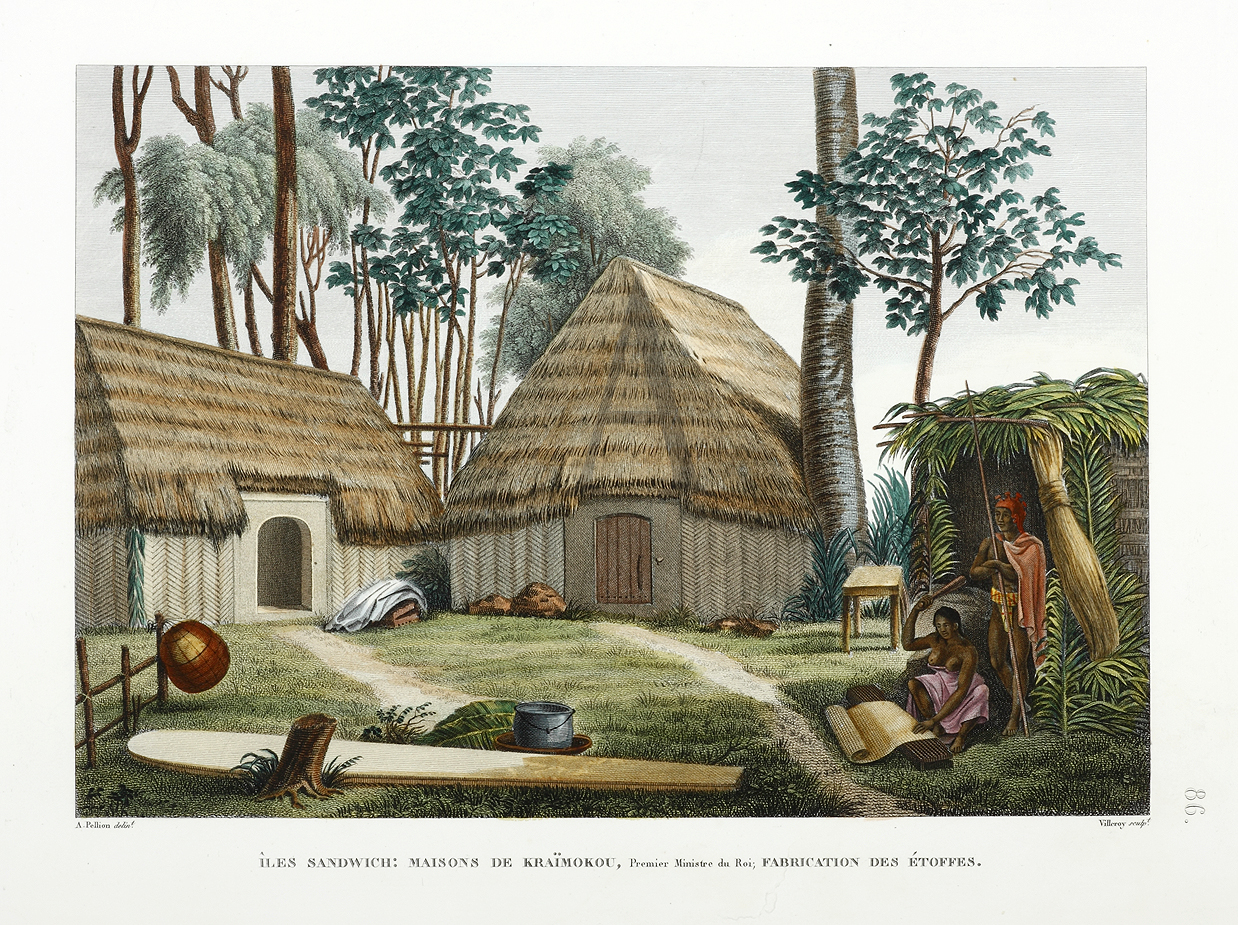
When Balzac Voclain arrives in Hawaiʻi in A Half Flower, he arrives with the rather unfortunate confidence of a man who believes the world can ultimately be explained.
He is a surgeon, after all. He has been trained to observe, diagnose, cut, stitch and, ideally, produce an answer. He comes from France with its own political wounds, religious conflicts and ideas about reason. Then he reaches Hawaiʻi—and finds himself in a kingdom where political power, religion, foreign influence and old ways of understanding the world are changing around him.
And then there are the visions he cannot explain.
That collision fascinated me when I began researching A Half Flower. Not a simple collision of “West” and “Hawaiʻi,” because neither side was simple enough for that. The Hawaiʻi of the 1820s was already changing before Protestant missionaries established themselves there. Hawaiian rulers disagreed among themselves. Foreigners arrived with conflicting motives. Christianity itself soon came in competing forms. Old beliefs did not conveniently disappear because a law or ruler changed.
It is one of those historical moments in which everyone is standing on moving ground.
Which is a wonderful place to set a novel.
A Half Flower begins in Lyon in 1816 before Balzac’s story carries him into the Hawaiian world of the 1820s. That setting became much more than scenery as I researched it. It shaped the conflicts, relationships and questions at the heart of the novel.
Hawaiʻi was changing before the missionaries arrived
It is tempting to tell Hawaiian history as a neat before-and-after story: traditional Hawaiʻi existed, Westerners appeared, missionaries arrived, and everything changed.
History was less obliging.
Kamehameha I had brought the islands under a single kingdom through warfare, diplomacy and agreement. When he died in 1819, his son Liholiho became Kamehameha II. But royal power did not rest on the young king alone. Kaʻahumanu, one of Kamehameha I’s wives, became kuhina nui and exercised enormous political authority alongside him.
That same year came one of the great internal breaks in Hawaiian history.
The traditional state religious system and the ʻai kapu—the restrictions that, among other things, governed which foods women could eat and prohibited men and women from eating together—were challenged by members of the ruling elite themselves. Liholiho publicly ate with women of his court, and orders followed to dismantle the old temple system. Not everyone agreed. Kekuaokalani and his supporters resisted the change by force, and fighting followed.
This happened before the first company of American Protestant missionaries arrived in 1820.
That sequence matters.
The missionaries became enormously influential, but they did not sail into an unchanging society and single-handedly overturn it. Hawaiian rulers had already made radical choices of their own, for their own reasons, and Hawaiians themselves disagreed about those choices. The old religious and political order was already being contested from within.
For a novelist, that is much more interesting than a tidy story about one culture replacing another.
It also creates the Hawaiʻi Balzac encounters: a kingdom in which the rules have changed, while the people who grew up under the old rules are still very much alive.
Ending a religious system does not end a worldview
Laws can change faster than people.
The dismantling of the old state religious system did not mean that generations of stories, sacred places, genealogies, fears, practices and ways of explaining the world suddenly vanished.
Nor did everyone respond to Christianity in the same way.
Kaʻahumanu eventually embraced Protestant Christianity and supported the missionaries. Other aliʻi also adopted the new religion, while Hawaiian responses varied according to place, rank, family, circumstance and conviction. By the middle of the decade, Protestant influence had become significant in the kingdom.
And then Christianity itself became part of another conflict.
In 1827, the first Catholic missionaries of the Congregation of the Sacred Hearts, led by Alexis Bachelot, arrived in Honolulu. Suddenly the religious question was not merely one of older Hawaiian beliefs and Christianity. There were rival Christian interests as well, accompanied by the politics of foreign nations.
That complexity found its way into A Half Flower.
Balzac is French. He is a surgeon. He has his own troubled relationship with religious authority. He enters Hawaiʻi expecting, as people generally do, that the categories inside his own head will continue to work once he reaches the other side of the world.
They do not.
The interesting question for me was never whether one group was “rational” and another “superstitious.” People in every culture make sense of what happens to them using the knowledge and assumptions available to them.
The interesting question is what happens when those explanations contradict one another—and then something happens that none of them can comfortably explain.
A kingdom learning to write without ceasing to remember
Researching Hawaiʻi also presented me with another problem: whose version of the past was I reading?
Before the nineteenth century, Hawaiian knowledge was transmitted primarily through oral forms: genealogy, chant, story, teaching, memory and practice. That does not mean Hawaiʻi had no history before writing. Quite the opposite. It means history was preserved differently.
The introduction of a Hawaiian writing system in the 1820s therefore produced an extraordinary change.
Protestant missionaries wanted Hawaiians to be able to read Christian texts, but literacy did not remain something foreigners controlled. Hawaiian aliʻi supported education, Hawaiian teachers taught other Hawaiians, and printing in the Hawaiian language began in 1822. Kauikeaouli, who became Kamehameha III, strongly supported literacy. Hawaiians adopted the technology remarkably quickly and eventually produced an enormous body of Hawaiian-language writing.
For me as a historical novelist, however, the transition creates an intriguing difficulty.
The closer I come to the beginning of the nineteenth century, the more often I encounter Hawaiʻi through somebody else’s pen: missionaries, sailors, traders and visitors describing what they believed they were seeing.
Those accounts are invaluable.
They are also accounts written by human beings.
A missionary naturally noticed different things from a merchant. A sailor noticed something else. A person attempting to convert Hawaiians had a reason to describe Hawaiian religious practice in a particular way. A visitor who remained for a fortnight could confidently explain customs understood rather differently by someone who had lived within them for a lifetime.
That does not make such sources useless. It makes reading them interesting.
One document may tell me what happened.
Another tells me what its writer thought happened.
Often I need both.
Early Hawaiʻi cannot be reconstructed responsibly from a single outsider’s description, however vivid that description may be.
The strange little flower that gave Naupaka its name
And then there is the flower.
Naupaka blossoms look as though somebody has removed half of each flower. The petals spread to one side, leaving the other strangely bare.
Unsurprisingly, people told stories about them.
One widely told version concerns Naupaka, a high-ranking young woman, and Kauʻi, a man of lower rank whom she loves. Their relationship cannot be accepted. After they seek help from a kahuna, the lovers are separated: one goes toward the mountains and the other toward the sea. The divided blossoms of naupaka become a reminder of their separation. Bishop Museum records the story as one among several explanations associated with the plant.
But this was one of my favourite discoveries during the research: there is not just one Naupaka story.
An older tradition connected to a chant for the Oʻahu chief Kualiʻi tells something quite different. Here Naupaka is a man, and his wife is ʻŌhikimakaloa. Jealousy drives them apart. In one telling of the tradition, she follows him with handmade lei, trying to restore their relationship, while he rejects her. Only later does Naupaka understand his mistake and seek her again. The chant itself places Naupaka in genealogy; later storytelling connects their separation with the oddly divided flower.
I love that.
Not because one version needs to defeat the other and become the correct legend, but because stories live.
They pass through different mouths and generations. Details shift. Meanings gather around them. A flower becomes a princess, a chief, a lover, a separation, a regret. What remains is the image of something that appears incomplete.
That image was irresistible to me.
The Naupaka series is filled with people separated by things larger than themselves: culture, religion, nationality, distance, family, history—and sometimes by their own remarkably poor decisions.
They want to cross those boundaries anyway.
So a half flower became the right symbol.
And eventually, the title of A Half Flower.
What would Balzac actually notice?
Historical research easily becomes a collection of dates.
Novels cannot.
Balzac does not wake up in the morning thinking, Ah yes. I appear to be living through an important period of Hawaiian cultural transformation.
He has patients.
He is hungry.
Someone irritates him.
Someone else fascinates him.
He misunderstands something.
And because he is Balzac, there is a reasonable chance that whatever he misunderstood will shortly become a serious problem.
That is where historical research becomes useful to me.
I want to know not simply who ruled Hawaiʻi, but what a person had been taught was proper. Who could speak first? What might clothing or featherwork communicate about rank? Who was permitted into a particular space? Which prohibition had disappeared officially but remained powerful in somebody’s memory? What did a European visitor notice—and what did he fail to notice because he did not know it mattered?
A small misunderstanding can tell us more about a historical world than three pages of explanation.
It also prevents the setting from becoming the decorative version of Hawaiʻi that is so easy to create from a distance: blue water, palms, mountains, paradise.
Those things exist.
So do political ambition, family obligations, disease, religion, foreign ships, trade, grief, humour, rivalry and people trying to work out what the future will demand of them.
That is the Hawaiʻi I wanted behind A Half Flower.
And then there is Balzac’s medicine
Balzac has one advantage when he enters this complicated world: he believes in evidence.
Unfortunately for him, A Half Flower is not particularly interested in making his life easy.
His medical training gives him a framework through which to understand bodies and illness. But early nineteenth-century European medicine was itself incomplete, contradictory and sometimes terrifying by modern standards. Balzac may consider himself the rational man in the room, but we, two centuries later, know perfectly well that his own science still has large holes in it.
That was too delicious a situation not to use.
So when he encounters ideas he does not understand—and when his own visions begin resisting the explanations available to him—his confidence becomes part of the problem.
He has to decide not only what is true, but how he knows it is true.
That question sits quietly beneath much of the Naupaka story.
History does something similar to us. We look backwards believing we know what happened because we know how the story ended. The people living through 1820s Hawaiʻi did not.
They did not know which religion would dominate.
They did not know what foreign powers would eventually do.
They did not know what parts of their world would survive, change or disappear.
They were simply living inside their present.
That is the perspective I try hardest to remember when I write historical fiction: historical people are not modern people waiting for history to catch up with them. They are people whose choices make sense—or fail to make sense—inside the world they actually knew. That principle has become one of the central rules behind my historical fiction.
The more I researched 1820s Hawaiʻi, the less simple it became
This is usually when I know I’ve found a setting worth writing about.
At the beginning of research, I think I understand it.
Then I discover another source.
And another person.
And another contradiction.
Before long, the tidy historical picture I had constructed has been ruined completely.
Excellent.
Because real places are like that.
The Hawaiʻi behind A Half Flower is a kingdom in transformation, but “transformation” should not be confused with a simple march from one world into another. Hawaiian rulers exercised power. Hawaiians embraced, resisted and adapted new ideas in different ways. Foreigners disagreed among themselves. Christianity arrived amid changes already underway. New forms of literacy appeared while much older forms of memory endured.
And somewhere inside all this I placed a stubborn French surgeon who would very much prefer reality to behave itself.
It does not.
I wouldn’t have given him such an interesting world if it did.
If you would rather enter this world through fiction, you can continue with A Half Flower Or, if you’re new here, the Free Starter Library includes the opening chapter along with maps, character material and more of the research behind my stories.
Sources
Research note: Historical Hawaiʻi survives through sources created from very different perspectives. Where accounts disagree, I try to distinguish documented events from later interpretations and oral traditions rather than flattening them into a single version of the past.
U.S. National Park Service — Kamakahonu / Kamehameha II. Excellent for the 1819 end of the kapu system, the conflict involving Kekuaokalani, and the arrival of Protestant missionaries in 1820. Kamakahonu, National Park ServiceHawaiʻi State Archives — Kaʻahumanu. This is the source I would use for Kaʻahumanu’s political authority, creation/use of the kuhina nui office, her role in the ʻAinoa, her later conversion, and her support for Protestant Christianity. Kaʻahumanu, Hawaiʻi State ArchivesUniversity of Hawaiʻi — Hawaiian Language. Particularly useful for the development of the written language, teaching by Hawaiian chiefs and teachers, the beginning of Hawaiian-language printing in 1822, and Kamehameha III’s support of literacy. Hawaiian Language history, University of HawaiʻiBernice Pauahi Bishop Museum — Plants of Hawaiʻi: Naupaka. Use this for the Naupaka/Kauʻi telling and the plant itself. Importantly, Bishop Museum describes naupaka as appearing in several stories, which supports the way we’ve written the article rather than presenting one modern version as the single ancient legend. Naupaka at Bishop MuseumLeilehua Yuen — “The Story of Naupaka and ʻŌhikimakaloa.” Use specifically for that variant and its connection with the genealogy/chant for Kualiʻi—not as the principal source for general Hawaiian history. Read the Naupaka and ʻŌhikimakaloa accountHiram Bingham, A Residence of Twenty-One Years in the Sandwich Islands (1847). Very useful as a primary missionary source, precisely because it should be read as the perspective of a participant rather than as neutral history. The Library of Congress has the complete public-domain book online. Read Bingham at the Library of CongressSamuel Manaiakalani Kamakau, Ruling Chiefs of Hawaii. I would include this in your research bibliography because Hawaiian historical accounts are especially valuable for balancing outsider missionary narratives. The Hawaiʻi State Archives itself cites Kamakau in its Kaʻahumanu material. Lilikalā Kameʻeleihiwa, Native Land and Foreign Desires: Pehea Lā E Pono Ai? Worth adding as a modern Hawaiian scholarly counterweight when you’re dealing with power, religion, land, foreign influence and interpretation.
Leave a Reply