
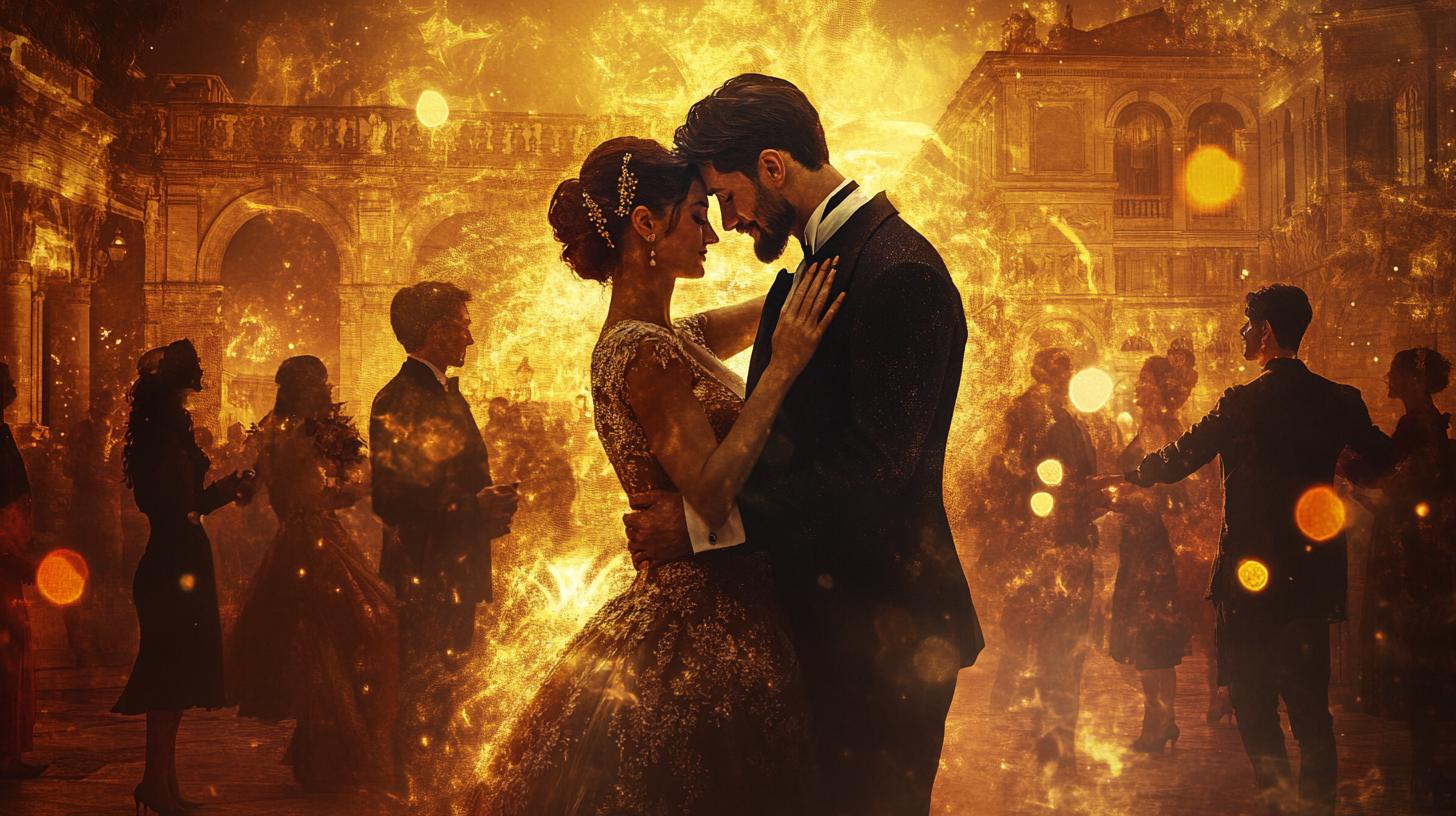
Historical romance can take you far beyond Regency ballrooms.
Depending on the period, a love story might unfold amid medieval dynastic politics, Renaissance courts, the dangerous maritime world of the Age of Sail, revolutionary upheaval, or the enormous social changes of the nineteenth century.
The historical setting matters because it changes what characters are allowed to do, what they risk by falling in love, and what marriage, money, family, reputation, religion, class, and duty mean to them.
If you’re looking for a new historical romance setting to explore, these seven eras offer very different kinds of stories.
1. The Ancient World: Egypt, Greece and Rome
Ancient settings offer enormous scale: royal courts, warfare, religious ritual, political alliances, trade, slavery, family dynasties, and empires rising or falling.
Romantic stories set in the ancient world often overlap with historical fiction, epic fiction, or myth retellings rather than fitting neatly into modern romance conventions.
That can be part of their appeal.
A relationship may be shaped by family strategy, citizenship, social rank, political allegiance, or expectations that feel very different from our own.
You may enjoy ancient settings if you like:
- epic-scale stories
- mythology and legend
- court politics
- ancient cultures
- political alliances and forbidden relationships
- characters whose personal lives collide with public events
The key is not to expect ancient characters simply to behave like modern people wearing historical clothes. Part of the pleasure is seeing how love, loyalty, marriage, inheritance, and family could operate within a very different social world.
2. Medieval Europe: Duty, Dynasties and Dangerous Loyalties
The medieval period covers centuries, countries, cultures, and political systems, so there is no single “medieval romance.”
A story set in twelfth-century England can feel very different from one set in fourteenth-century France, medieval Scotland, the Iberian Peninsula, or the Italian city-states.
But medieval settings often give romance writers powerful sources of conflict: inheritance, arranged marriage, family alliances, warfare, religious authority, land, loyalty, and social rank.
Love may be intensely personal while marriage is anything but.
You may enjoy medieval romance if you like:
- castles and fortified towns
- political marriages
- family rivalries
- knights, nobles, merchants, or religious communities
- questions of loyalty and honour
- high external stakes around a relationship
One useful distinction is between medieval history and the later romantic image of the Middle Ages. Knights, courtly love, castles, and chivalry have accumulated centuries of storytelling around them.
The most interesting historical fiction often asks what life beneath those familiar images might actually have felt like.
3. Renaissance and Early Modern Romance
The Renaissance and early modern centuries offer another kind of historical-romance world: courts, expanding trade networks, religious conflict, artistic patronage, diplomacy, printing, exploration, and intense political change.
For fiction, this can create settings where people are surrounded by new ideas while still constrained by old structures.
Marriage may involve wealth, family strategy, religion, inheritance, or political advantage. At the same time, cities and courts can bring strangers, artists, merchants, diplomats, scholars, and travellers into contact.
You may enjoy Renaissance settings if you like:
- court intrigue
- art and culture
- political manoeuvring
- religious conflict
- powerful families
- secret relationships
- cosmopolitan cities and trade networks
This period works especially well for readers who like romance intertwined with politics rather than isolated from it.
4. The Age of Sail and Maritime Romance
This is the historical world I find especially fascinating.
From roughly the seventeenth century into the early nineteenth, oceans connected ports, empires, merchants, navies, smugglers, privateers, migrants, enslaved people, sailors, missionaries, adventurers, and travellers.
The sea created movement—but not equality.
People crossed enormous distances while living inside systems of class, empire, race, law, gender, and commerce that shaped where they could go and what choices they could make.
That gives maritime historical fiction much more to work with than the familiar pirate fantasy.
Maritime romance can include:
- naval conflict
- merchant shipping
- smuggling and privateering
- port cities
- long voyages
- separation and reunion
- cultural encounters
- shipboard hierarchies
- migration
- danger created by weather, war, law, or distance
For romance, distance itself becomes useful.
Characters may be thrown together aboard ship, separated by oceans, trapped in unfamiliar ports, or forced to depend on someone they would never have met at home.
And the sea creates a setting where private choices can collide very quickly with larger historical forces.

Want to explore my historical worlds?
My free Historical Fiction Starter Library includes first chapters, maps, character guides, and research from behind my novels.
You can explore the world of A Half Flower, which moves between early nineteenth-century France and Hawaiʻi, or enter the smuggling world behind The Adventuress.
5. Georgian and Regency Romance
The Regency itself lasted only from 1811 to 1820, when the future George IV governed Britain as Prince Regent for his father, George III.
But what readers often call “Regency romance” draws on a somewhat wider late-Georgian world.
This setting has become one of the most recognizable parts of historical romance: country houses, London society, balls, inheritance, family reputation, marriage markets, and strict expectations about respectable behaviour.
Those conventions give writers an efficient source of romantic tension.
A conversation, dance, visit, letter, inheritance, or engagement can carry consequences that would be difficult to reproduce in a contemporary setting.
You may enjoy Regency romance if you like:
- witty dialogue
- social comedy
- marriage-of-convenience stories
- class differences
- family pressure
- country estates
- balls and social rituals
- characters trying to bend rules without destroying their reputations
It is also worth remembering that this polished social world existed alongside war, poverty, colonial expansion, industrial change, and enormous inequalities.
Historical romance becomes richer when that wider world is not completely erased.
6. Nineteenth-Century America
The nineteenth-century United States gives historical romance writers many possible settings rather than one single “frontier.”
Stories may unfold during the early republic, the Civil War, Reconstruction, westward expansion, the Gilded Age, or the growth of rapidly changing cities.
Each carries different historical pressures.
Migration, slavery and emancipation, Indigenous displacement, war, industrialization, immigration, class, race, land ownership, and changing expectations for women all shaped relationships and family life.
You may enjoy nineteenth-century American settings if you like:
- characters building or rebuilding lives
- migration stories
- family sagas
- war and its aftermath
- rapidly changing communities
- social mobility and its limits
- city-versus-country settings
- stories about belonging and reinvention
Older historical romance sometimes treated the “frontier” primarily as a backdrop for freedom and adventure.
Contemporary readers and writers have more reason to ask whose freedom, whose land, and whose version of the pastthe story presents.
That does not make the period less interesting. It makes it more complex.
7. Victorian Britain: Love in a Changing Society
The Victorian era runs from 1837 to 1901, covering more than six decades of enormous change.
Railways, industry, expanding cities, scientific developments, political reform, empire, mass publishing, changing work, and debates around women’s rights all altered British life.
That makes “Victorian romance” much broader than corsets, drawing rooms, and suppressed passion.
You may enjoy Victorian settings if you like:
- Gothic atmosphere
- mysteries and secrets
- industrial cities
- changing class structures
- unconventional heroines
- social reform
- family reputation
- old wealth colliding with new money
- relationships constrained by public expectations
The period is useful for romance because society was changing quickly enough to create friction between inherited rules and new possibilities.
Characters can want lives that their families or communities do not yet know how to accommodate.
Which Historical Romance Era Should You Start With?
Choose according to the kind of conflict you enjoy.
If you like epic stories and mythology, begin with the ancient world.
If you like dynasties, castles, loyalty, and political marriage, try medieval settings.
If court intrigue, art, religion, and political manoeuvring appeal to you, explore the Renaissance and early modern world.
If you want adventure, travel, ships, ports, cultural collision, and danger, try the Age of Sail.
If you love banter, social rules, family pressure, and marriage plots, Regency romance may be the easiest place to begin.
If you prefer reinvention, migration, conflict, and rapidly changing societies, explore nineteenth-century America.
And if you enjoy Gothic atmosphere, industrial change, secrets, class tension, and changing expectations for women, Victorian fiction offers enormous variety.
You do not need to choose the most popular period.
Choose the historical world that makes you curious.
Historical Romance or Historical Fiction With Romance?
The two overlap, but they are not always the same thing.
In genre romance, the central romantic relationship normally drives the story and readers expect an emotionally satisfying romantic resolution.
Historical fiction may contain an important love story without making that relationship the primary plot.
That distinction can help when choosing your next book.
If what you most want is the relationship, look for historical romance.
If what attracts you first is the historical world—with romance as one important part of it—then broader historical fictionmay suit you better.
Many readers enjoy both.
How Much Historical Knowledge Do You Need?
Very little to begin.
A good historical novel should give you enough context to understand what matters without requiring a history degree.
You may encounter unfamiliar customs, political events, clothing, occupations, laws, or social expectations, but that is part of the discovery.
If something catches your attention, follow it.
Read the author’s note. Look at a map. Search for the real event behind the fictional one. Compare the novel with a nonfiction account.
Historical fiction is often most enjoyable when the story opens a door and curiosity takes you through it.
Does Historical Romance Need to Be Historically Accurate?
Historical fiction always involves invention.
Authors create dialogue, private emotions, relationships, and often entire characters. Even when real people appear, fiction cannot know every private conversation or motive.
But historical setting should still matter.
For me, the most convincing historical fiction does not simply decorate modern characters with old clothing. The laws, beliefs, dangers, opportunities, social expectations, geography, and material world of the period should put pressure on the choices characters make.
Historical accuracy does not mean turning a novel into a textbook.
It means making the past consequential.
Why Historical Setting Changes a Love Story
Love may feel universal, but the choices surrounding it are not.
Who could marry whom? Who controlled money? Could a woman own property? How far could someone travel? What happened to a marriage across class, religion, nationality, or race? What did divorce mean? What did reputation cost? How private could a relationship actually be?
Those answers change across periods and places.
That is why historical romance can offer something contemporary romance cannot.
The historical world itself becomes part of the obstacle.
And when history puts pressure on a relationship, characters have to choose what they are willing to risk.
Ready to Find Another Historical World?
If unfamiliar history is part of what you love about fiction, you can explore more of the worlds behind my novels in the free Historical Fiction Starter Library.
You’ll find first chapters, historical maps, character guides, and research from behind A Half Flower and The Adventuress.
Enter the Free Starter Library
FAQs
Which historical romance period is best for beginners?
For readers new to historical romance periods, I always recommend starting with Regency romance as your gateway period. The Regency era (1811-1820) offers the perfect balance of historical flavor and accessibility, making it ideal for beginners exploring historical romance periods for the first time.
Authors like Jane Austen established the foundation, while contemporary writers like Julia Quinn and Lisa Kleypas have created beginner-friendly entry points with witty dialogue and relatable characters. The social structures are complex enough to create romantic tension but simple enough to understand quickly.
Regency historical romance periods work so well for beginners because they combine elegant historical settings with familiar romantic tropes, allowing you to ease into historical fiction without feeling overwhelmed by unfamiliar customs or complex political situations.
How historically accurate should historical romance be?
The best historical romance periods strike a careful balance between entertainment and education, prioritizing emotional authenticity over rigid historical accuracy. As an author who researches 1820s maritime settings extensively, I believe historical romance should feel authentic without becoming a history textbook.
Well-researched historical romance periods like those by authors such as Loretta Chase or Courtney Milan demonstrate how accurate historical details enhance rather than overwhelm the romantic story. Conversely, fantasy historical romance takes more liberties with historical facts while maintaining period atmosphere.
The key is author transparency about their research approach and reader choice in accuracy preferences. Some readers prefer meticulously researched historical romance periods, while others enjoy more romanticized versions of history. Both approaches are valid when done skillfully.
Can I enjoy historical romance without knowing much history?
Absolutely! You can thoroughly enjoy historical romance periods without extensive historical knowledge. In fact, romance novels often serve as an excellent gateway to learning about different eras in an entertaining, accessible way.
The best historical romance periods are written to be enjoyed by readers regardless of their historical background. Authors typically weave necessary context into their narratives naturally, allowing you to learn about historical settings through engaging storytelling rather than dry exposition.
Many readers discover their passion for specific historical romance periods through novels, then pursue additional historical learning because the stories sparked their curiosity. Romance authors often include historical notes and recommended reading lists to help interested readers explore further. Trust your curiosity and dive in—the historical knowledge will come naturally as you explore different periods.
What if I don’t like the first book I try in a new historical romance period?
Don’t give up on entire historical romance periods based on one disappointing book! This is completely normal in the exploration process, and it’s crucial to distinguish between disliking a specific author’s style versus disliking the historical period itself.
Try at least 2-3 different authors within the same historical romance period before deciding it’s not for you. Each author brings their own interpretation and focus to historical settings—one might emphasize political intrigue while another focuses on social comedy or adventure.
Consider what specifically didn’t appeal to you: was it the writing style, the historical details, the romantic pacing, or the period itself? This analysis helps you make better choices for your next exploration of historical romance periods. Persistence often leads to discovering hidden gems within periods that initially seemed unappealing.
Leave a Reply