Historical fiction can take you from Tudor England to wartime France, ancient Greece, Korea, Hollywood, and revolutionary societies—all while keeping the human story at the center.
If you’re looking for your next read, I’ve chosen 15 historical novels for different kinds of readers: accessible books if you’re new to the genre, more demanding novels for readers who love deep historical immersion, and distinctive picks worth exploring beyond the obvious classics.
I write historical fiction myself, so I’m particularly interested in the point where research, setting, character, and story meet. Use it to find the kind of historical fiction you want to read next.
The 15 historical fiction books at a glance
Accessible starting points
- All the Light We Cannot See by Anthony Doerr — World War II France and Germany
- The Seven Husbands of Evelyn Hugo by Taylor Jenkins Reid — twentieth-century Hollywood
- The Book Thief by Markus Zusak — Nazi Germany
- The Help by Kathryn Stockett — 1960s Mississippi
- The Nightingale by Kristin Hannah — occupied France during World War II
For deeper historical immersion
- Wolf Hall by Hilary Mantel — Tudor England
- The Pillars of the Earth by Ken Follett — medieval England
- Pachinko by Min Jin Lee — Korea and Japan across generations
- Outlander by Diana Gabaldon — eighteenth-century Scotland, with time travel
- The Song of Achilles by Madeline Miller — ancient Greek myth and the Trojan War
Distinctive reads to explore next
- Salt to the Sea by Ruta Sepetys — refugees and the Wilhelm Gustloff disaster
- Hamnet by Maggie O’Farrell — Shakespeare’s family and Elizabethan England
- The Alice Network by Kate Quinn — women, espionage, and two world wars
- Memoirs of a Geisha by Arthur Golden — twentieth-century Kyoto
- A Gentleman in Moscow by Amor Towles — post-revolutionary Russia
Not sure where to start? Choose an accessible starting point if you want a strong story with relatively easy entry into the historical setting. Try the deeper-immersion group if historical detail and complex narratives are part of the pleasure for you. The final group offers settings, structures, or perspectives that take you in somewhat different directions.
Accessible Historical Fiction Books to Start With
1. All the Light We Cannot See by Anthony Doerr
Setting: France and Germany during World War II
The novel follows Marie-Laure, a blind French girl forced to flee Paris, and Werner, a German orphan whose talent for radio technology draws him into the machinery of Nazi Germany. Their separate stories move gradually toward the besieged city of Saint-Malo.
Why read it: Doerr combines an intimate human scale with the enormous pressures of war. The alternating perspectives make the conflict feel personal without reducing it to a simple division between heroes and villains.
Best for: Readers who enjoy lyrical prose, parallel narratives, morally complicated characters, and stories about survival and human connection.
Content note: War, Nazi persecution, violence, death, and loss.
2. The Seven Husbands of Evelyn Hugo by Taylor Jenkins Reid
Setting: Hollywood across much of the twentieth century
A reclusive film star chooses an unknown journalist to hear the story of her life: seven husbands, a spectacular career, carefully managed scandals, and a private self that often had little in common with the woman presented to the public.
Why read it: The novel is extremely readable, but beneath the glamour it explores ambition, sexuality, image-making, and the compromises people make when the culture around them leaves little room for the truth.
Best for: Readers who like Old Hollywood, complicated women, secrets, romance, and fast-moving character-driven stories.
Content note: Domestic abuse, sexuality, homophobia, grief, and difficult relationships.
3. The Book Thief by Markus Zusak
Setting: Nazi Germany during World War II
Liesel Meminger is sent to live with foster parents outside Munich. As war tightens around her, stolen and borrowed books become part of the way she understands fear, friendship, persecution, and the power of language.
The novel is famously narrated by Death, giving a familiar historical setting an unusual perspective.
Why read it: It combines a young protagonist with an inventive narrative voice and a story about words themselves—the ways they can be used to manipulate, comfort, resist, and remember.
Best for: Readers who like emotionally intense stories, unusual narrators, books about books, and civilian perspectives on wartime history.
Content note: Antisemitism, Nazi persecution, bombing, war, death, and grief.
4. The Help by Kathryn Stockett
Setting: Jackson, Mississippi, in the early 1960s
The novel brings together Aibileen and Minny, Black women working in white households, and Skeeter, a young white woman who wants to become a writer. Their decision to document the experiences of domestic workers puts all three at risk.
Why read it: It is an accessible, discussion-heavy novel about race, domestic work, class, friendship, and the social structures of the Jim Crow South.
It is also worth reading critically. The story is a white author’s fictional treatment of Black women’s experiences, so I would not treat it as a substitute for memoir, history, or Black-authored accounts of the period.
Best for: Book clubs and readers interested in social history, relationships across rigid social divisions, and the American Civil Rights era.
Content note: Racist language, segregation, discrimination, abuse, and violence.
5. The Nightingale by Kristin Hannah
Setting: France under German occupation during World War II
Two sisters respond to war very differently. Vianne tries to protect her family and survive occupation, while Isabelle takes increasingly direct risks against the occupying forces.
Their different choices allow the novel to explore both visible resistance and the quieter moral compromises of civilian survival.
Why read it: Hannah puts women’s wartime experiences at the center and builds the story around family, courage, endurance, and the cost of choices made under extreme pressure.
Best for: Readers who like emotionally intense family stories, female protagonists, wartime resistance, and historical fiction designed to make you feel the stakes personally.
Content note: War violence, sexual assault, starvation, persecution, trauma, and death.
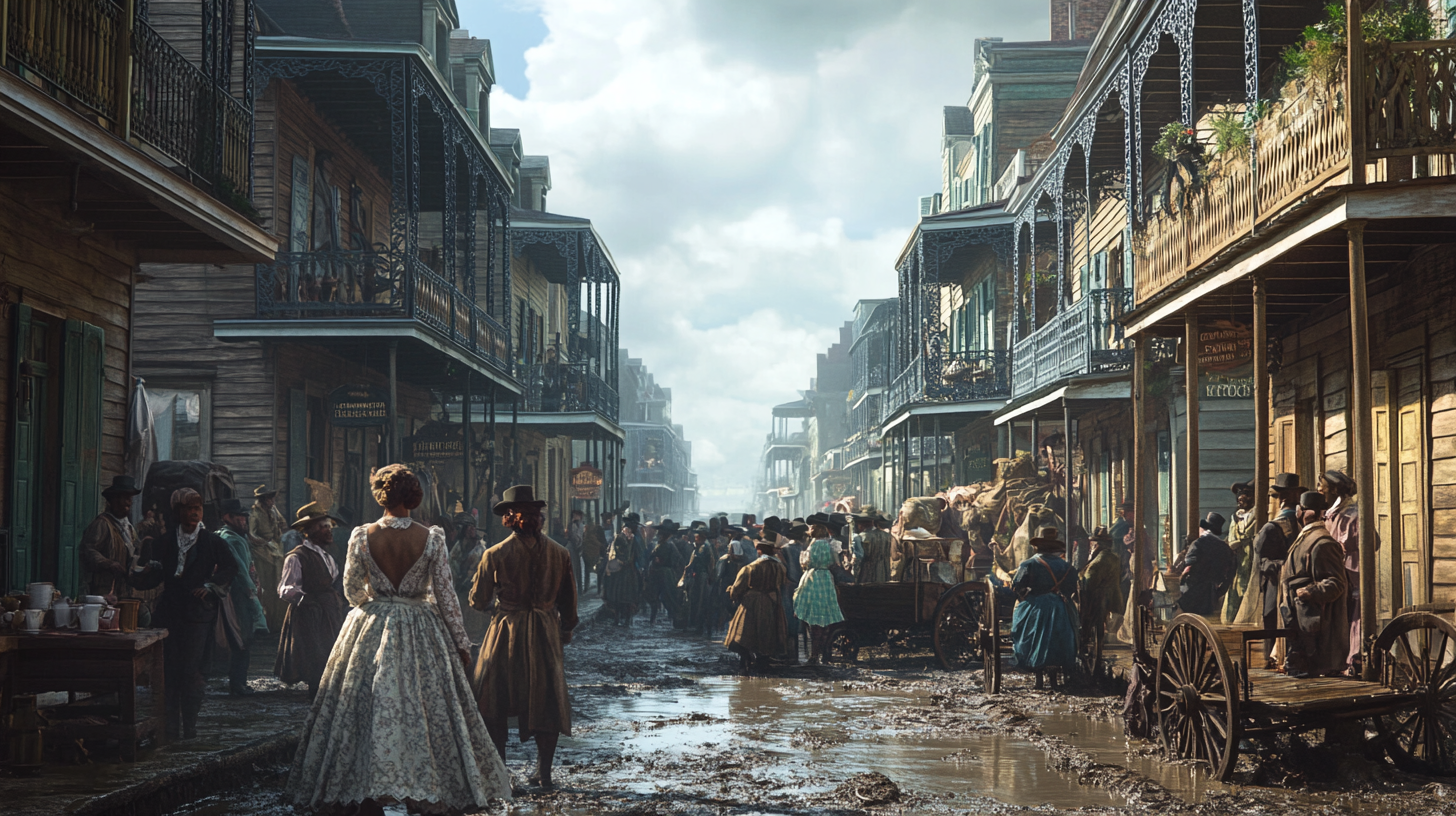
Want to Step Into Another Historical World?
If you love historical fiction because you want to disappear into another time—not simply be told what happened there—my free Historical Fiction Starter Library gives you first chapters, historical maps, character guides, and research from behind my novels.
Start with A Half Flower, set between early nineteenth-century France and 1820s Hawaiʻi, or enter the world of smugglers and New Orleans through The Adventuress.
Historical Fiction for Deeper Immersion
6. Wolf Hall by Hilary Mantel
Setting: Tudor England during the reign of Henry VIII
Thomas Cromwell rises from an unremarkable background into the dangerous center of royal power as Henry VIII seeks to end his marriage to Catherine of Aragon and marry Anne Boleyn.
Rather than treating Cromwell simply as a familiar historical villain, Mantel places the reader close to his perspective: observant, pragmatic, ambitious, and constantly assessing danger.
Why read it: Wolf Hall shows what historical fiction can do when it refuses to flatten famous people into fixed roles. The politics are complex, the characterization subtle, and the court feels like a place where every conversation has consequences.
Best for: Readers who enjoy political intrigue, Tudor history, literary fiction, and morally complicated protagonists.
Content note: Execution, political and religious violence, death, and court intrigue.
7. The Pillars of the Earth by Ken Follett
Setting: Twelfth-century England during a period of civil war and instability
At the center of this enormous novel is the building of a cathedral. Around it, Follett creates a world of masons, monks, merchants, nobles, families, rivalries, hunger, faith, ambition, and violence.
Why read it: The appeal is scale. Buildings, economics, politics, religion, and everyday survival all shape what the characters can and cannot do. The cathedral gives the sprawling story a strong center while decades of lives unfold around it.
Best for: Readers who love long books, medieval settings, multi-character sagas, architecture, and immersive world-building.
Content note: Graphic violence, sexual violence, cruelty, religious conflict, and other difficult material.
Ken Follett describes the novel as an epic set against twelfth-century England and the civil conflict beginning in 1135.
8. Pachinko by Min Jin Lee
Setting: Korea and Japan across much of the twentieth century
Beginning with Sunja and extending across generations, Pachinko follows a Korean family whose lives are shaped by migration to Japan, colonial history, poverty, discrimination, family obligation, and the desire to build something lasting.
Why read it: History is not simply an event in the background here. Political systems, ethnicity, money, language, family reputation, and migration affect what each generation believes is possible.
Best for: Readers who enjoy multigenerational sagas, family history, migration stories, East Asian history, and novels concerned with identity and belonging.
Content note: Colonialism, racism, poverty, sexual material, family conflict, and loss.
9. Outlander by Diana Gabaldon
Setting: Scotland in 1743, reached from 1945 through time travel
Claire Randall, a former wartime nurse, is mysteriously transported from postwar Scotland into the eighteenth century. Her medical knowledge and modern assumptions immediately make her both useful and dangerously out of place.
Her relationship with Jamie Fraser develops amid clan politics, violence, loyalty, war, and the growing Jacobite conflict.
Why read it: Outlander is historical fiction blended with romance, adventure, and speculative fiction. Claire’s position as an outsider gives the reader a built-in comparison between modern expectations and an eighteenth-century social world.
Best for: Readers who enjoy long series, romance, adventure, Scottish history, and a little fantasy with their historical fiction.
Content note: Explicit sex, violence, sexual assault, torture, war, and physical punishment.
10. The Song of Achilles by Madeline Miller
Setting: The world of Greek myth and the Trojan War
Told by Patroclus, the novel reimagines his relationship with Achilles from youth through the war at Troy. The familiar heroic story becomes intimate, personal, and increasingly tragic.
Why read it: This is historical-adjacent rather than conventional historical fiction: myth, epic poetry, and imaginative retelling overlap. Miller makes legendary figures emotionally immediate while keeping fate, glory, violence, and mortality at the center.
Best for: Readers who enjoy mythology, lyrical prose, tragic love stories, queer narratives, and reinterpretations of classical material.
Content note: War, violence, sexual material, death, and grief.
Distinctive Historical Fiction Reads
11. Salt to the Sea by Ruta Sepetys
Setting: East Prussia in 1945
Four young people fleeing the collapsing Eastern Front make their way toward the ship Wilhelm Gustloff. Their individual stories converge around a real maritime disaster that remains far less widely known than many other tragedies of World War II.
Why read it: Short chapters and multiple narrators keep the story moving quickly, while the historical setting introduces readers to refugee experiences and wartime events often missing from the most familiar World War II narratives.
Best for: Readers interested in overlooked history, refugee stories, young protagonists, and emotionally intense but fast-paced fiction.
Content note: War violence, sexual assault, death, trauma, and the deaths of children.
12. Hamnet by Maggie O’Farrell
Setting: Elizabethan England
O’Farrell imagines the family life behind one of the few firmly known facts about Shakespeare’s children: his son Hamnet died at eleven.
The novel centers much of its emotional attention on Agnes, Shakespeare’s wife, and on the grief that enters the family with the boy’s death.
Why read it: Rather than building a conventional biography around Shakespeare, Hamnet turns toward marriage, parenthood, household life, illness, and bereavement. The result is intimate rather than monumental.
Best for: Readers who like literary historical fiction, domestic history, Shakespeare, lyrical prose, and emotionally concentrated novels.
Content note: Child death, plague, illness, grief, and mourning.
13. The Alice Network by Kate Quinn
Setting: France during World War I and Europe after World War II
The novel connects two timelines. One follows Eve Gardiner and a female espionage network during World War I; the other follows Charlie St. Clair after World War II as she searches for a missing relative.
Their stories eventually converge around memory, justice, trauma, and the long consequences of war.
Why read it: The espionage plot gives the novel thriller momentum, while the dual timeline lets Quinn explore women whose wartime roles were far more dangerous and complicated than conventional histories sometimes suggest.
Best for: Readers who like female spies, wartime mysteries, dual timelines, found-family dynamics, and page-turning historical fiction.
Content note: Torture, sexual violence, war, alcoholism, trauma, and loss.
14. Memoirs of a Geisha by Arthur Golden
Setting: Kyoto before, during, and after World War II
The novel is presented as the life story of Sayuri, who enters a geisha house as a child and is trained for a highly structured world of performance, patronage, competition, and social expectation.
Why read it: The novel is immersive and strongly visual, with particular attention to ritual, clothing, performance, status, and the disruptions brought by war.
It should, however, be read as fiction rather than as an authoritative guide to geisha culture. Its representation of Japanese women and geisha life has been the subject of substantial criticism and debate.
Best for: Readers drawn to richly described settings, coming-of-age stories, twentieth-century Japan, and novels that invite further reading around their historical context.
Content note: Child exploitation, sexual coercion, abuse, war, and restricted female agency.
The novel follows Sayuri from childhood in 1929 through her life as a geisha before, during, and after World War II.
15. A Gentleman in Moscow by Amor Towles
Setting: Moscow from the 1920s onward
Count Alexander Rostov is sentenced to house arrest in the Hotel Metropol after the Russian Revolution. Rather than ranging across the country, the novel allows decades of Soviet history to pass through one confined setting.
Rostov loses his former social position but gradually builds a life around friendships, routines, responsibilities, and people he would never have known in his previous world.
Why read it: The limited setting becomes one of the book’s strengths. Large historical changes remain visible, but the novel keeps asking a smaller question: what makes a meaningful life when freedom is restricted?
Best for: Readers who prefer character to action, elegant prose, Russian settings, quiet humor, and historical fiction concerned with dignity and adaptation.
Content note: Political repression, imprisonment, displacement, death, and loss.
How I Chose These Historical Fiction Books
I wanted this list to offer more than fifteen versions of the same historical world.
The books move across centuries and continents and range from accessible page-turners to slower, more demanding literary fiction. Some are conventional historical novels; others cross into romance, mythology, fantasy, or speculative fiction.
What matters to me is not whether every book fits inside a perfectly sealed genre box. I am looking for stories in which the historical world matters to the characters: where politics, belief, class, war, culture, medicine, gender, migration, religion, or social expectation changes what people can do and what choices cost them.
That is also why I have not ranked these books from number one to number fifteen. The “best” historical novel depends on what you want from it.
If you want a highly accessible starting point, try All the Light We Cannot See or The Nightingale.
If you want political complexity, try Wolf Hall.
If you want an enormous immersive world, try The Pillars of the Earth.
If you want a multigenerational family story, try Pachinko.
If you want mythology and lyrical tragedy, try The Song of Achilles.
And if you want a historical novel built around the quiet question of how to live well under constraint, try A Gentleman in Moscow.
A Note on Historical Accuracy
Historical fiction is still fiction.
A novel may use real events, places, social structures, objects, beliefs, and historical people while inventing private conversations, motivations, relationships, or entire characters. Some novels stay very close to documented events. Others deliberately blend history with romance, mythology, fantasy, or speculation.
I find historical fiction most rewarding when it makes me curious enough to look beyond the novel: to read the author’s note, examine a map, search for the historical person behind a character, or find out which part of the story really happened.
That is where fiction can become the beginning of historical discovery rather than the end of it.
Frequently Asked Questions About Historical Fiction Books
What is a good historical fiction book to start with?
It depends on what you already enjoy.
For an accessible wartime novel, try All the Light We Cannot See or The Nightingale. For family sagas, try Pachinko. For political intrigue, try Wolf Hall. For romance and adventure, try Outlander. For a very large medieval world, try The Pillars of the Earth.
Are historical fiction books true?
Historical fiction combines invention with the past. The historical setting, events, or people may be real, but a novelist normally invents at least some characters, dialogue, relationships, or private events.
A historical novel can be carefully researched without every scene being historically documented.
Does historical fiction have to be completely accurate?
No novel can reproduce the past perfectly, and fiction requires imagination.
What matters is whether departures from the historical record are deliberate and whether the invented story remains convincing within the world the author has created. If historical accuracy is especially important to you, read the author’s notes and follow interesting details into nonfiction sources.
What makes a book historical fiction?
Historical fiction places an invented story substantially in the past and uses that historical world as more than decoration.
The period should affect the characters’ lives: their expectations, opportunities, dangers, beliefs, relationships, work, language, or political circumstances.
What are some of the best historical fiction books for book clubs?
Books with moral questions, conflicting perspectives, or strong historical context often work particularly well.
From this list, Pachinko, The Help, Hamnet, The Nightingale, A Gentleman in Moscow, and The Alice Network all give readers plenty to discuss.
What if I want historical fiction that is not about World War II?
There is much more to the genre than World War II.
Try Wolf Hall for Tudor England, The Pillars of the Earth for the Middle Ages, Pachinko for Korea and Japan across the twentieth century, Outlander for eighteenth-century Scotland, The Song of Achilles for the world of Greek myth, or A Gentleman in Moscow for Soviet Russia.
What Should You Read Next?
The easiest way to choose is not to ask which historical fiction book is objectively “best,” but which historical world you want to enter next.
Do you want court politics, war, family history, migration, romance, espionage, mythology, or a story built around everyday life in a radically different world?
Start there.
A good historical novel does more than put costumes around a modern story. It makes the past exert pressure on the people living inside it—and for a while, lets us live there too.
2 responses to “15 Best Historical Fiction Books to Read in 2026”
-
This guide is fantastic. It’s well organized and full of books that sound genuinely exciting to read.
-
Thank you Douglas, I appreciate it!
-


Image credits: Pixabay.com; Ri_Ya, Ylanite, Rosy_Photo, congerdesign, cocoparisienne, un-perfekt, josealbafotos, JessBaileyDesign, Pexels, PDPics.
Leave a Reply