

Before Sherlock Holmes became one of fiction’s most famous detectives, he was simply an eccentric young man looking for someone to share the rent at 221B Baker Street.
A Study in Scarlet, first published in 1887, introduces both Sherlock Holmes and Dr. John Watson—and already contains much of what would make their partnership so entertaining: murder, observation, scientific deduction, dry humor, and Watson’s persistent inability to see what Holmes considers perfectly obvious.
It is also a peculiar first novel. Halfway through, Doyle temporarily abandons Holmes, Watson, and London altogether. The story jumps roughly twenty years into the past and crosses the Atlantic to the American West, where an entirely different set of characters begins to reveal the history behind the London murders.
Does it work?
Mostly. The sudden interruption damages the momentum of the London investigation, but the American backstory gives the crime something Holmes’s deductions alone do not provide: motive, grief, and a character’s history.

My verdict
★★★★☆ — Four of five Golden Books
Clever, funny, atmospheric, and enormously important to detective fiction. The abrupt second half interrupts an otherwise excellent pace, and its sensationalized portrayal of nineteenth-century Mormonism should not be mistaken for reliable history. Yet by the end, Doyle has managed something rather impressive: the murderer is no longer simply a murderer, Holmes has demonstrated why ordinary detectives cannot compete with him, and nearly every thread has been neatly tied.
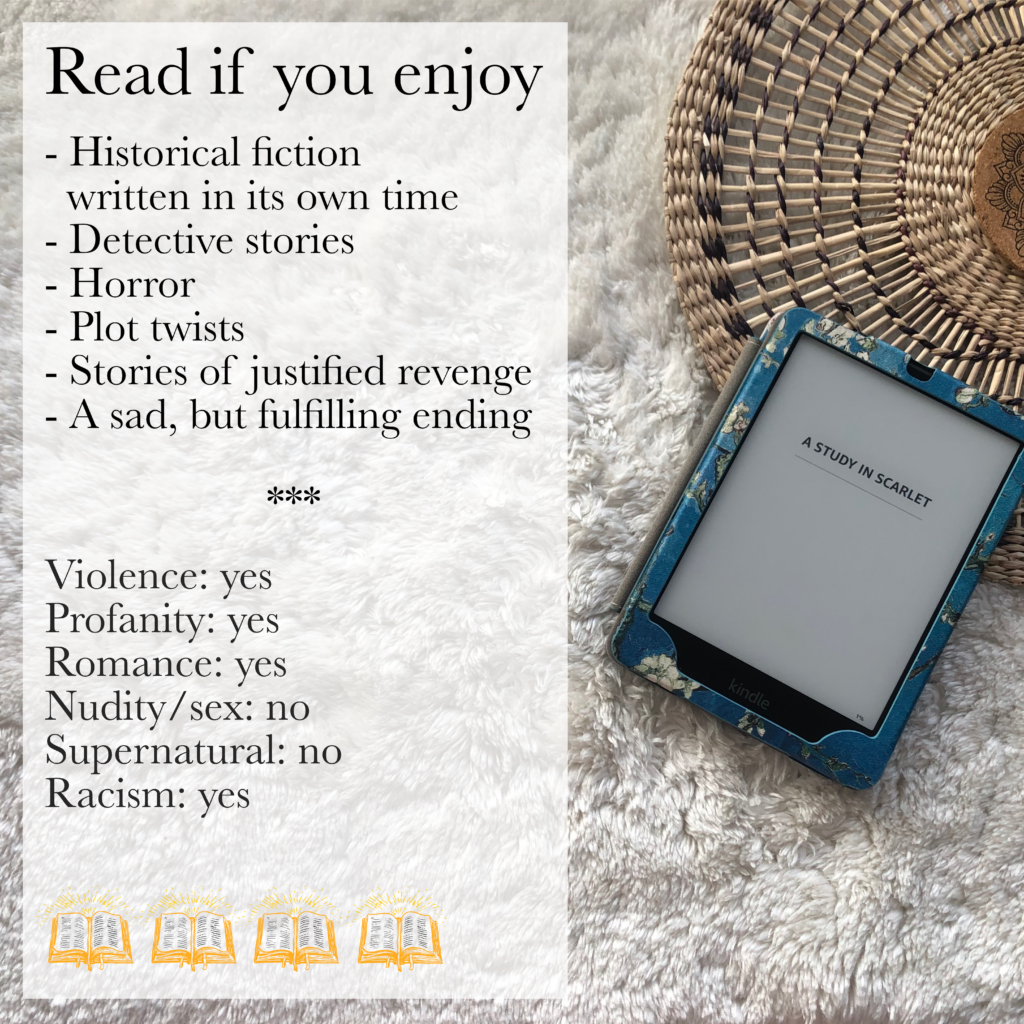
I would recommend it—with one warning:
When Part Two begins and you wonder whether someone has accidentally glued another book into yours, keep reading.
A Study in Scarlet at a Glance
Author: Sir Arthur Conan Doyle
First published: 1887
Series: Sherlock Holmes #1
Genre: Detective fiction / mystery
Setting: London and the American West
Narrator: Dr. John Watson, with a third-person section in Part Two
My rating: ★★★★☆
Best for: Readers who enjoy classic mysteries, Victorian fiction, unusual story structures, and books that reveal almost as much about the period that produced them as about their fictional characters.
How Sherlock Holmes Began
Arthur Conan Doyle wrote A Study in Scarlet in 1886. After the manuscript met with rejection, Ward, Lock & Co. bought the copyright for £25 and published it in Beeton’s Christmas Annual in November 1887. It was the first published story featuring Sherlock Holmes and Dr. Watson. The story did not immediately make Holmes a sensation; Doyle himself later recalled that it had “no particular success” at the time. Holmes’s enormous popularity developed later, particularly after the Sherlock Holmes short stories began appearing in The Strand Magazine in 1891.
Doyle knew medicine rather better than most novelists writing about doctors. He studied medicine at the University of Edinburgh from 1876 to 1881, graduated in medicine and surgery in 1881, and received his M.D. in 1885. One of his Edinburgh teachers, Dr. Joseph Bell, was known for drawing startling conclusions about patients from close observation and became an important inspiration for Holmes.
This helps explain one of the delights of the book. Holmes does not merely announce that he is clever. Doyle gives him a method.
And poor Watson gets to stand beside him while he demonstrates it.
Synopsis of A Study in Scarlet – no major spoilers

A Study in Scarlet is the first of the Sherlock Holmes books, so if you’re considering reading what I consider one of the best historical fiction series, this is the story to begin with. The plot of A Study in Scarlet is arguably inelegantly divided into two stories and separate parts. Let’s have a look at what this means.
A Study in Scarlet debuts with Dr. Watson, the narrator throughout the Sherlock Holmes series (with small exceptions to confirm the rule), introducing himself and explaining how he came to his unfortunate position. After a shot in the shoulder in Afghanistan and months of typhoid in Peshawar, our poor narrator is brought home to England to improve his health with eleven shillings and sixpence a day. In “the great wilderness of London” (ironically coming from someone who just returned from wars in then-India and Afghanistan), Dr. Watson soon realizes his allowance is not much.
So he looks for a roommate, which is how we’re introduced to Sherlock Holmes. Dr. Watson asserts he is too weak to bear much excitement or noise, and Mr. Holmes assures him, apart from the occasional violin playing, he is a quiet fellow. They move in together, and all seems fine. Until Mr. Holmes’ guest visits increase intolerably, and Dr. Watson is pushed into the confines of his room.
Dr. Watson grows curious about Sherlock Holmes, and due to his not being able to go out nor having many friends in London, grows obsessed with figuring out what “the deuce” Sherlock Holmes is up to. He even makes a list of his accomplishments to find a clue, but throws it into the fire, finding nothing useful. One morning at breakfast Sherlock Holmes and Dr. Watson discuss an article about the power of deduction, and when Dr. Watson declares it humbug, Mr. Holmes confesses he’s a consulting detective, the only one in the world, and that he wrote the article.

Want to see the criminals’ side of things?
Jean Laffite: smuggler, pirate, and gentleman. He toyed with the authorities, and not much they could do about it. Dive into his world in the first novelette in the series One Virtue And A Thousand Crimes.
To prove his point, Mr. Holmes deduces information about a man standing across the street, who then comes up the stairs as the next client. Which is how Dr. Watson is drawn into the curious case of a dead man in an empty house. Dr. Watson is intrigued when he finds Mr. Holmes was correct in every deduction, and the reader realizes Dr. Watson is not as fragile after his war experiences as he assumed. He loses his limp.
Lestrade and Gregson, “the smartest of the Scotland Yarders,” await at the crime scene on Brixton road. Sherlock Holmes inspects the body, discovers “RACHE” written in blood on the wall, and the two official detectives give a report of their findings. Mr. Holmes smirks at their conclusions and wishes them luck on the scents they pursue.
Mr. Holmes pursues his own clues, uses the ring the detectives hadn’t noticed to entice the potential murderer by advertisement in the lost and found section, and is generally busy and gone for several days, much to the dismay of our narrator Dr. Watson, who is even more clueless than the detectives, but ever more intrigued by Sherlock Holmes.
Show spoiler
It’s yours for $1.00
Buy the annotated version with interesting information about places, outdated jobs mentioned, and much more.
Why Does A Study in Scarlet Suddenly Leave London?
This is the most startling structural choice in the book.
Part One builds pace beautifully. Watson meets Holmes. Holmes demonstrates his strange abilities. A murder appears. Clues multiply. Gregson and Lestrade race after their own theories. Holmes quietly seems to know more than everyone else.
Then Doyle stops everything.
New continent.
New narrator.
New time.
New characters.
For a modern reader, it can feel as though another novel has accidentally been bound into the first.
I do think it hurts the pacing. The London story has become increasingly difficult to put down, and the Utah section asks the reader to abandon almost every character and question that created that momentum.
Yet I also think the deviation is essential to what the book ultimately achieves.
The first half asks:
Who committed the crime?
The second asks:
What would make a person commit it?
That distinction matters.
The murderer ceases to be an abstract problem for Holmes to solve and becomes a person whose actions we may condemn while still understanding the emotions behind them.
By the end, the story is satisfyingly round. The strange second half that initially appears to break the novel is also what gives its crime emotional weight.
It works.
But not gracefully.
How Accurate Is the Mormon Section?
This is one place where the fact that A Study in Scarlet was written in the nineteenth century becomes especially important.
Doyle’s Utah is a frightening place ruled by religious authoritarianism, secret surveillance, forced marriages, threats, and violence. The story uses the mysterious Danites—or “Avenging Angels”—almost as a hidden police force capable of eliminating anyone who resists.
It makes excellent material for a thriller.
It should not be treated as a reliable account of nineteenth-century Latter-day Saint life.
Doyle had no firsthand knowledge of Mormonism when he wrote the novel. Research into the origins of the Utah section has connected it to the hostile and often sensational accounts of Mormonism circulating widely in British books, magazines, and newspapers during the period. Decades later, Doyle himself described his portrayal as a sensational and over-coloured picture of the Danite episodes.
That does not make the section useless to anyone interested in history.
Rather, it changes what kind of historical evidence it is.
A Study in Scarlet tells us less reliably what Utah was actually like than it tells us what a British writer—and, presumably, many of his readers—could imagine Utah to be like in the 1880s.
For me, that is one of the joys and dangers of reading fiction written in its own period.
The author explains what he thinks is strange.
He rarely explains what he thinks is normal.
And sometimes the second category tells us far more.
Evaluation of A Study in Scarlet
Model for the genre of detective stories
The novelette A Study in Scarlet is the first story in the Sherlock Holmes series, which became, along with the earlier works – Edgar Allan Poe’s Dupin stories and Émile Gaboriau’s Lecoq tales – the model for modern detective stories. The inciting incident of a new client, usually received in private chambers, which leads to ever more confusing clues which only the detective can unravel using analytical thought, climaxes with a chase, death, or both, to end with the conclusion of the detective’s success and sometimes his failure. This structure is iconic, and not without reason. A Study in Scarlet already follows this story structure. Also, much of what we now associate with Sherlock Holmes is already present in this first adventure: the unusual detective, the less brilliant but immensely useful narrator, the baffled official police, the apparently insignificant clue, the demonstration of deduction, the competing theories, the solution nobody else could see. Still, the unexpected detour into Mormon life is challenging and not consistent with Doyle’s later Sherlock Holmes works.
Sir Arthur Conan Doyle was well aware of his predecessors and the expectation for this then-new genre. The narrator himself offers meta textual acknowledgement in an interesting comparison of Sherlock Holmes with Edgar Allan Poe’s Dupin and shortly after Émile Gaboriau’s Lecoq:
“You remind me of Edgar Allan Poe’s Dupin. I had no idea that such individuals did exist outside of stories.”
Which Sherlock Holmes does not take as a compliment, though he acknowledges the good intention. And later:
“‘Have you read Gaboriau’s works?’ I asked. ‘Does Lecoq come up to your idea of a detective?’”
Which also offends Mr. Holmes, for after some arguments of his own he answers, “It might be made a text-book for detectives to teach them what to avoid.”
So while A Study in Scarlet is a wobbly start into the detective genre due to its diversion into the American desert, with this debut the narrator promises readers a new, unique, and more analytical detective series than existed before. Doyle fully lives up to his promises, as both his success and the quality of the stories that follow in the Sherlock Holmes series attest.
Vivid characters
A Study in Scarlet also offers character depth for the reader entering the Sherlock Holmes world, and Dr. Watson, the narrator, takes good time to introduce himself, his comrade Sherlock Holmes, and the others.
Sherlock Holmes is and remains a purely analytical man, entrenched in the English Conservative Enlightenment of the 1800s where empirical philosophy (Watson actually mentions “philosophical tools” lying around in their flat), polite manners, and science were the values of a true enlightened gentleman. Doyle perfected this stereotype. The inspiration, Doyle reported, was one of his medical professors. His character does not change in this novelette, nor in the following stories.
Dr. Watson, on the other hand, has a satisfying character arc in A Study in Scarlet. He starts out somewhat depressed and considering himself fragile, and becomes an enthusiastic accomplice to the “amateur” detective Sherlock Holmes. This is most vividly shown in the fact that his limp disappears.
The official detectives don’t change. Lestrade is described “lean and ferret-like,” and Gregson as “flaxen-haired” and tall, and that they “have their knives into one another,” to the extent that they are “jealous as a pair of professional beauties.” They are portrayed as proud, ignorant in comparison to Sherlock Holmes, and as somewhat depraved for having no problem with taking the credit for Mr. Holmes’ work. The “scarlet thread of murder” ties all these characters together.
Twisty plot and morally challenging theme
A Study in Scarlet is not entirely plot-focused, nor only character-driven, which, according to Raymond Chandler, a fellow detective story author, is essential for this genre. He defines the perfect story model as an “adventure in search of a hidden truth,” and therefore gives rigid demands to theme.
Show spoiler
The narrator in The Honour of the Flag, for example, tries to achieve a similar effect by relying on court decisions, but, unlike the narrator in A Study in Scarlet, does not gain the modern reader’s sympathy for the evil doer. The deviation does impact pacing, though.
Interrupted pace
The excellently quickening pace in A Study in Scarlet is sadly halted when the narrator turns from first person to omnipresent, distant third person and we’re thrown into a desert on another continent twenty years before the murder. As the names of the murderer and victim appear, the pace slowly picks up again. It is fully back on track when we return to the murder story at the end of part two.
The book is much funnier than reputation suggests
In A Study in Scarlet, the image-filled prose, fledged with small archaisms, a tad of dialect, and truly historical world views, sparkles with humor. With the interactions between strong characters, the narrator manages to make us smirk almost on every page while the story unfolds in London.
For example, when the police officers meet with Sherlock Holmes, they invariably display their incompetence to him, and he rubs it under their noses:
“’I have left everything untouched.’ [Gregson]
‘Except that!’ my friend answered, pointing at the pathway. ‘If a herd of buffaloes had passed along there could not be a greater mess.’”
Sir Arthur Conan Doyle in A Study in Scarlet
What A Study in Scarlet reveals about 1887
Later on, Sherlock Holmes lets the officer pair Gregson and Lestrade loose on their hot scents, knowing they will return with more questions and fewer answers, and when he listens to each of their report, for they come to tell him proudly, Sherlock says he considers his news quite exciting, and yawns. It is also humorous how much detail the officers remark on, as if trying to impress Sherlock, and with this only show the reader how far off the track they have gone.
The narrator sometimes also uses humorous characterizations such as when he describes Lestrade as “lean and ferret-like as ever,” which does not distract from serving as a vivid and necessary characterization. The narrator is, however, also a man of his time when he attributes physical appearance as giving clues to character. It was a popular belief in the nineteenth century, and the narrator has this view when he describes Sherlock Holmes’ physical appearance:
“His eyes were sharp and piercing, save during those intervals of torpor to which I have alluded [opium]; and his thin, hawk-like nose gave his whole expression an air of alertness and decision. His chin, too, had the prominence and squareness which mark the man of determination.”
Sir Arthur Conan Doyle in A Study in Scarlet
This truly historical world view shows even more when Sherlock Holmes uses his skills of deduction to discover the work of the man standing across the street:
“‘He was a man with some amount of self-importance and a certain air of command. You must have observed the way in which he held his head and swung his cane. A steady, respectable, middle-aged man, too, on the face of him—all facts which led me to believe that he had been a sergeant.’”
Sir Arthur Conan Doyle in A Study in Scarlet
It may be true that a man’s work was easier to discern back then, but it still seems unrealistic to a modern reader. Many jobs common at the time of penning have been lost, such as Boot (British, dated: a person employed in a hotel to clean boots and shoes, Oxford Dictionary of English), milk boy, or the racist “street Arabs” Sherlock employs, among other lost occupations. This truly historical world view is underscored with archaisms and dialect, much out of use nowadays in fiction. For example, we would not describe people lingering on the street as “loafers,” or describe someone as “dumbfoundered,” though it would surprise us to read someone “Ain’t afeared,” or hear an exclamation of “The last ink,” when someone solves a case. But these expressions also paint a historical picture and add to the vividness.
Doyle’s imagery also adds to the vividness of his prose. For example, when Mr. Holmes and Dr. Watson discuss Darwin’s theory, relatively young back then:
“There are vague memories in our souls of those misty centuries when the world was in its childhood.”
Sir Arthur Conan Doyle in A Study in Scarlet
The most prominent and entertaining of Doyle’s narrative features, and which has captured readers for centuries, is his subtle and universal humor. A consulting detective didn’t exist back then, nor does it now, and no official detective would be happy to feel himself forced to consult an “amateur.”
Impact
Upon finishing the novelette A Study in Scarlet I was moved to thinking. Where do I draw the line for sympathy with a murderer? Why was I happy someone I sympathized with died of heart failure? Was the Mormon way of life portrayed biased? Could there be some good to it?

Recommendable?
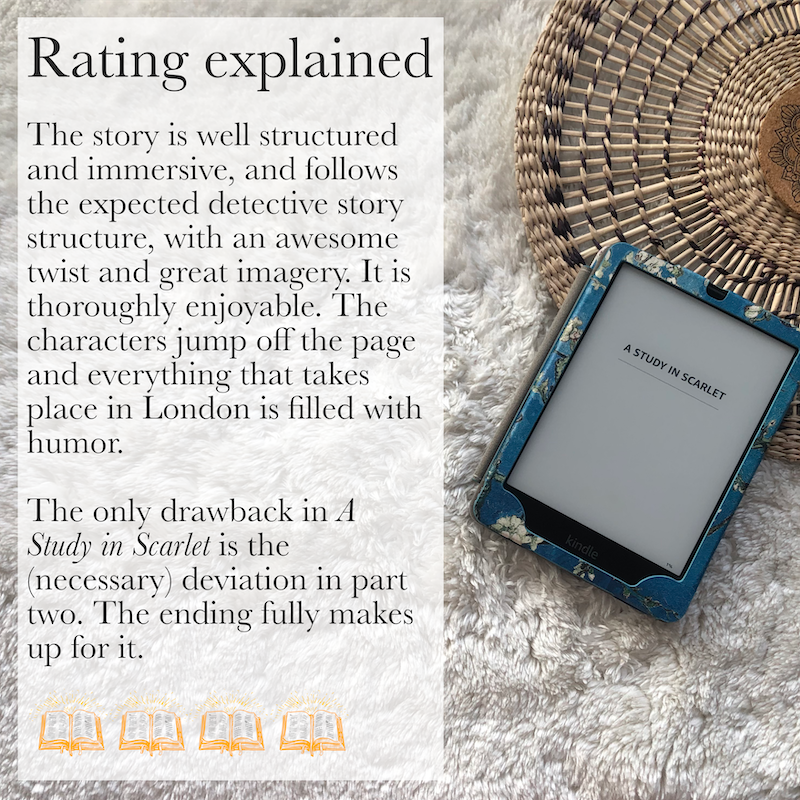
I would definitely recommend A Study in Scarlet to friends. I would warn them about the confusion they might experience at the beginning of part two, but I would tell them to continue reading because the ending makes up for it.
Golden Books Rating of A Study in Scarlet

Four of five Golden Books for A Study in Scarlet by Sir Arthur Conan Doyle.
Violence
Yes
Profanity
Yes
Romance
Yes
Nudity/sex
No
Supernatural
No
Racism
Yes
The only drawback in A Study in Scarlet is the (necessary) deviation in part two.
Want the Historical Details While You Read?
Old books constantly mention things their original readers already understood.
Jobs disappear. Expressions change. Places acquire new names. Social assumptions become strange. An ordinary object can become mysterious simply because nobody has used one for a century.
That is one of the reasons I enjoy annotated classics.
My annotated edition of A Study in Scarlet adds explanations for places, outdated occupations, unfamiliar expressions, period details, and other small things hiding inside Doyle’s story.
Sources
- Sir Arthur Conan Doyle: A Study in Scarlet.
- https://conandoyleestate.com/news/on-this-day-in-history-arthur-conan-doyles-a-study-in-scarlet-was-first-published#:~:text=A%20Study%20in%20Scarlet%20is,Beeton%27s%20Christmas%20Annual%20in%201887 (see for an interesting photo of Doyle’s notes on Sherlock Holmes, A Study in Scarlet).
- PAGE, ANTHONY. “RATIONAL DISSENT, ENLIGHTENMENT, AND ABOLITION OF THE BRITISH SLAVE TRADE.” The Historical Journal, vol. 54, no. 3, 2011, pp. 741–72. JSTOR, http://www.jstor.org/stable/23017270. Accessed 19 Dec. 2023.
- Irwin, John T. “Mysteries We Reread, Mysteries of Rereading: Poe, Borges, and the Analytic Detective Story; Also Lacan, Derrida, and Johnson.” MLN, vol. 101, no. 5, 1986, pp. 1168–215. JSTOR, https://doi.org/10.2307/2905715. Accessed 19 Dec. 2023.
FAQ
When was A Study in Scarlet published?
A Study in Scarlet first appeared in Beeton’s Christmas Annual in November 1887. It was the first published Sherlock Holmes story.
Is A Study in Scarlet the First Sherlock Holmes Book?
Yes. It introduces Sherlock Holmes and Dr. John Watson and tells the story of how they meet and begin living together at 221B Baker Street.
Is A Study in Scarlet Historical Fiction?
Not in the usual genre sense. Doyle was writing contemporary fiction in the 1880s rather than reconstructing a distant historical period.
For a modern reader, however, the novel has considerable historical value because its language, social assumptions, occupations, attitudes, and everyday details come directly from the period in which it was written.
Why Does A Study in Scarlet Suddenly Move to Utah?
Part Two travels backward in time to explain the history and motive behind the London murders.
The sudden change of setting, narrator, and period can be confusing, but the two stories eventually join.
What is the main theme of A Study in Scarlet?
A Study in Scarlet explores the uneasy difference between understanding a crime and excusing it, the triumph of analytical thinking (reverse logic) over normal thinking, and death.
Its structure also forces the reader to reconsider the murderer after learning the history behind the murders.
Who should read A Study in Scarlet?
If you enjoy historical fiction written in its own time, can stomach a few archaic expressions, enjoy worldviews deeply set in historical times, and are not put off by enriching diversions, A Study in Scarlet is perfect for you. And if Part Two makes you suspect you picked up the wrong book: keep reading.
Is the Mormon History in A Study in Scarlet Accurate?
It should not be read as reliable history.
Doyle had no firsthand knowledge of Mormon Utah when he wrote the novel and drew on sensational nineteenth-century accounts already circulating in British print culture. He later acknowledged that his depiction had been over-coloured.
Like what you’re reading? Share it!
Thank you Douglas, I appreciate it!
This guide is fantastic. It’s well organized and full of books that sound genuinely exciting to read.
Thank you Blogi Nauki, I appreciate it! 🙂
Reading this piece felt like walking through a beautiful garden of ideas — each thought more inviting than the last.
Thanks TyT! I appreciate it! 🙂


Leave a Reply